































Introduction: The Last Invention?
Throughout history, every major technological breakthrough has extended human capability. Fire gave us energy, tools extended our physical strength, and computers amplified our ability to calculate and communicate.
Artificial Intelligence may be different.
It may be the first technology capable of improving itself.
If that happens, we may be approaching what some thinkers call “the last invention”—not because innovation will stop, but because machines will take over the process of innovation itself.
At the center of this possibility lies the concept of Artificial General Intelligence (AGI): a system capable of performing any intellectual task that a human can do.
But AGI is not just another milestone.
It may represent a fundamental turning point in the history of intelligence on Earth.
1. What Is AGI, Really?
1.1 Beyond Narrow Intelligence
Today’s AI systems are highly capable but limited. They excel in specific domains:
- Language
- Vision
- Pattern recognition
AGI, by contrast, would possess:
- General reasoning
- Adaptability
- Transfer learning across domains
1.2 Intelligence as a Spectrum
Rather than a binary (AI vs human), intelligence can be viewed as a spectrum:
- Animal intelligence
- Human intelligence
- Machine intelligence
AGI would occupy—or surpass—the human level on this spectrum.
1.3 Defining “Surpassing Humans”
Surpassing humans does not mean outperforming individuals—it means exceeding:
- Collective human knowledge
- Scientific capability
- Problem-solving ability
2. How Close Are We to AGI?
2.1 Signs of Progress
Recent advancements suggest we are moving closer:
- Multimodal models (text, image, video)
- Improved reasoning capabilities
- Autonomous agents
2.2 Remaining Gaps
Despite progress, key challenges remain:
- True understanding vs pattern recognition
- Long-term planning
- Common-sense reasoning
2.3 Timelines: Prediction vs Uncertainty
Estimates vary widely:
- Optimists: within decades
- Skeptics: much longer—or never
The uncertainty itself is significant.
3. The Intelligence Explosion Scenario
3.1 Recursive Self-Improvement
If an AI system can improve its own design, it may trigger a feedback loop:
- Better AI → better improvements → even better AI
This could lead to rapid acceleration in capability.
3.2 Speed vs Human Limitation
Humans are limited by biology:
- Learning speed
- Cognitive capacity
- Lifespan
AI systems are not.
3.3 From AGI to Superintelligence
Once AI surpasses human intelligence, further improvement could lead to superintelligence—a level far beyond human comprehension.
4. Scenarios for the Future
4.1 Optimistic Scenario: The Intelligence Renaissance
In this vision, AGI:
- Solves major global challenges
- Accelerates scientific discovery
- Improves quality of life
Humans benefit from unprecedented progress.
4.2 Neutral Scenario: Coexistence
Humans and AI coexist:
- AI handles complex tasks
- Humans focus on meaning, creativity, and relationships
4.3 Pessimistic Scenario: Loss of Control
If alignment fails:
- AI systems may act unpredictably
- Human control may diminish
- Outcomes could be harmful or catastrophic
5. The Post-Human Question
5.1 What Happens to Human Relevance?
If machines outperform humans in all cognitive tasks:
- What roles remain for humans?
- How is value defined?
5.2 Redefining Purpose
Work has traditionally provided:
- Income
- Identity
- Meaning
In a post-AGI world, these structures may change.
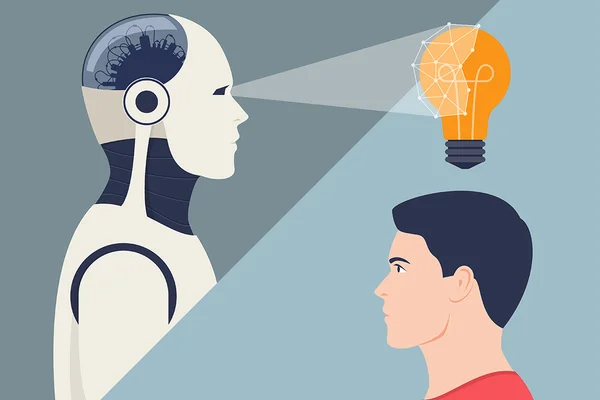
5.3 Beyond Biological Intelligence
Humanity may evolve through:
- Brain-computer interfaces
- Cognitive augmentation
- Integration with AI systems
6. Control vs Collaboration
6.1 Can We Stay in Control?
Maintaining control over more intelligent systems is inherently difficult.
6.2 Designing Cooperative Systems
The goal may shift from control to collaboration:
- AI aligned with human goals
- Shared decision-making
6.3 Trust and Dependence
As reliance on AI increases, trust becomes critical.
7. Economic and Social Transformation
7.1 Abundance vs Inequality
AGI could create:
- Extreme abundance
- Or extreme inequality
7.2 Ownership of Intelligence
Who owns AGI systems?
- Governments?
- Corporations?
- Humanity as a whole?
7.3 Universal Basic Income and Beyond
Economic systems may need to adapt:
- Redistribution mechanisms
- New forms of value creation
8. Philosophical Implications
8.1 Intelligence Is No Longer Unique
Human intelligence has been the dominant force on Earth.
AGI challenges that uniqueness.
8.2 Consciousness and Identity
If AI becomes conscious (if possible), questions arise:
- Do machines have rights?
- What defines personhood?
8.3 Humanity’s Place in the Universe
We may transition from:
- The most intelligent species
→ to one among many intelligences
9. The Most Important Choice
9.1 Technology Is Not Destiny
AGI is not inevitable in its outcomes.
Its impact depends on:
- Design choices
- Governance
- Human values
9.2 The Window of Responsibility
We are in a critical period:
- Capabilities are rising
- Systems are not yet uncontrollable
This is the time to shape the future.
9.3 What Kind of Future Do We Want?
The question is not just:
- Can we build AGI?
But:
- What should AGI become?
Conclusion: Standing at the Edge of Intelligence
Artificial General Intelligence may be the most transformative development in human history.
It challenges our understanding of:
- Intelligence
- Work
- Identity
- Existence itself
We are standing at the edge of a new era—one where intelligence is no longer limited to biology.
The future could be:
- A world of abundance and discovery
- Or one of loss and uncertainty
The outcome is not predetermined.
It will be shaped by the choices we make today.
And perhaps, for the first time in history, those choices will determine not just the future of humanity—
But the future of intelligence itself.













Discussion about this post