





















techfusionnews
  • Home
  • Digital Lifestyle
    Can Cryptocurrency Replace Traditional Banking?

    Can Cryptocurrency Replace Traditional Banking?

    Is Augmented Reality Changing How We Learn?

    Is Augmented Reality Changing How We Learn?

    The Dark Side of the Smart City Revolution

    The Dark Side of the Smart City Revolution

    Can You Escape the Surveillance State with VPNs?

    Can You Escape the Surveillance State with VPNs?

    Are Digital Detoxes Just a Trend or a Necessity?

    Are Digital Detoxes Just a Trend or a Necessity?

    Is Social Media Helping or Hurting Your Mental Health?

    Is Social Media Helping or Hurting Your Mental Health?

  • Green Tech & Wellness
    Can Circular Economy Principles Revolutionize Healthcare?

    Can Circular Economy Principles Revolutionize Healthcare?

    Is AI the Secret to Personalized Eco-Wellness Solutions?

    Is AI the Secret to Personalized Eco-Wellness Solutions?

    How Do Green Building Materials Affect Your Overall Wellbeing?

    How Do Green Building Materials Affect Your Overall Wellbeing?

    Could Plant-Based Diets Be the Future of Eco-Friendly Wellness?

    Could Plant-Based Diets Be the Future of Eco-Friendly Wellness?

    How Can Smart Green Gadgets Improve Indoor Air Quality?

    How Can Smart Green Gadgets Improve Indoor Air Quality?

    Can Clean Energy Revolutionize Your Fitness Routine?

    Can Clean Energy Revolutionize Your Fitness Routine?

  • AI
    Will AI Ever Truly Understand Human Consciousness?

    Will AI Ever Truly Understand Human Consciousness?

    What Role Will AI Play in the Next Evolution of the Internet?

    What Role Will AI Play in the Next Evolution of the Internet?

    How Will AI Transform the Future of Education?

    How Will AI Transform the Future of Education?

    Can AI Understand and Create Humor?

    Can AI Understand and Create Humor?

    Is AI the Key to Unlocking Human Potential?

    Is AI the Key to Unlocking Human Potential?

    How Close Are We to AI Becoming Sentient?

    How Close Are We to AI Becoming Sentient?

  • Space Exploration
    Will We Ever Reach the Edge of the Observable Universe?

    Will We Ever Reach the Edge of the Observable Universe?

    What Are the Ethical Implications of Colonizing Other Planets?

    What Are the Ethical Implications of Colonizing Other Planets?

    What If Earth’s Magnetic Field Collapsed—Could We Survive in Space?

    What If Earth’s Magnetic Field Collapsed—Could We Survive in Space?

    Can Artificial Intelligence Assist in Discovering Exoplanets?

    Can Artificial Intelligence Assist in Discovering Exoplanets?

    Is Space Debris a Threat to Future Space Exploration?

    Is Space Debris a Threat to Future Space Exploration?

    Could We Use Wormholes to Travel Through Time and Space?

    Could We Use Wormholes to Travel Through Time and Space?

  • Innovation & Research
    Can Innovation Thrive Without Government Funding?

    Can Innovation Thrive Without Government Funding?

    Are We Ready for the Ethical Challenges of AI in Research?

    Are We Ready for the Ethical Challenges of AI in Research?

    How Can Failure Be the Most Important Lesson in Innovation?

    How Can Failure Be the Most Important Lesson in Innovation?

    Can the Digital Transformation of Research Lead to Global Scientific Unity?

    Can the Digital Transformation of Research Lead to Global Scientific Unity?

    What is the True Value of Interdisciplinary Research in Innovation?

    Why Do Some Scientific Discoveries Fail to Make an Impact?

    Why Do Some Scientific Discoveries Fail to Make an Impact?

  • All Tech
    Will AI Ever Truly Understand Human Consciousness?

    Will AI Ever Truly Understand Human Consciousness?

    Can Cryptocurrency Replace Traditional Banking?

    Can Cryptocurrency Replace Traditional Banking?

    Can Circular Economy Principles Revolutionize Healthcare?

    Can Circular Economy Principles Revolutionize Healthcare?

    Can Innovation Thrive Without Government Funding?

    Can Innovation Thrive Without Government Funding?

    Will We Ever Reach the Edge of the Observable Universe?

    Will We Ever Reach the Edge of the Observable Universe?

    What Role Will AI Play in the Next Evolution of the Internet?

    What Role Will AI Play in the Next Evolution of the Internet?

techfusionnews
  • Home
  • Digital Lifestyle
    Can Cryptocurrency Replace Traditional Banking?

    Can Cryptocurrency Replace Traditional Banking?

    Is Augmented Reality Changing How We Learn?

    Is Augmented Reality Changing How We Learn?

    The Dark Side of the Smart City Revolution

    The Dark Side of the Smart City Revolution

    Can You Escape the Surveillance State with VPNs?

    Can You Escape the Surveillance State with VPNs?

    Are Digital Detoxes Just a Trend or a Necessity?

    Are Digital Detoxes Just a Trend or a Necessity?

    Is Social Media Helping or Hurting Your Mental Health?

    Is Social Media Helping or Hurting Your Mental Health?

  • Green Tech & Wellness
    Can Circular Economy Principles Revolutionize Healthcare?

    Can Circular Economy Principles Revolutionize Healthcare?

    Is AI the Secret to Personalized Eco-Wellness Solutions?

    Is AI the Secret to Personalized Eco-Wellness Solutions?

    How Do Green Building Materials Affect Your Overall Wellbeing?

    How Do Green Building Materials Affect Your Overall Wellbeing?

    Could Plant-Based Diets Be the Future of Eco-Friendly Wellness?

    Could Plant-Based Diets Be the Future of Eco-Friendly Wellness?

    How Can Smart Green Gadgets Improve Indoor Air Quality?

    How Can Smart Green Gadgets Improve Indoor Air Quality?

    Can Clean Energy Revolutionize Your Fitness Routine?

    Can Clean Energy Revolutionize Your Fitness Routine?

  • AI
    Will AI Ever Truly Understand Human Consciousness?

    Will AI Ever Truly Understand Human Consciousness?

    What Role Will AI Play in the Next Evolution of the Internet?

    What Role Will AI Play in the Next Evolution of the Internet?

    How Will AI Transform the Future of Education?

    How Will AI Transform the Future of Education?

    Can AI Understand and Create Humor?

    Can AI Understand and Create Humor?

    Is AI the Key to Unlocking Human Potential?

    Is AI the Key to Unlocking Human Potential?

    How Close Are We to AI Becoming Sentient?

    How Close Are We to AI Becoming Sentient?

  • Space Exploration
    Will We Ever Reach the Edge of the Observable Universe?

    Will We Ever Reach the Edge of the Observable Universe?

    What Are the Ethical Implications of Colonizing Other Planets?

    What Are the Ethical Implications of Colonizing Other Planets?

    What If Earth’s Magnetic Field Collapsed—Could We Survive in Space?

    What If Earth’s Magnetic Field Collapsed—Could We Survive in Space?

    Can Artificial Intelligence Assist in Discovering Exoplanets?

    Can Artificial Intelligence Assist in Discovering Exoplanets?

    Is Space Debris a Threat to Future Space Exploration?

    Is Space Debris a Threat to Future Space Exploration?

    Could We Use Wormholes to Travel Through Time and Space?

    Could We Use Wormholes to Travel Through Time and Space?

  • Innovation & Research
    Can Innovation Thrive Without Government Funding?

    Can Innovation Thrive Without Government Funding?

    Are We Ready for the Ethical Challenges of AI in Research?

    Are We Ready for the Ethical Challenges of AI in Research?

    How Can Failure Be the Most Important Lesson in Innovation?

    How Can Failure Be the Most Important Lesson in Innovation?

    Can the Digital Transformation of Research Lead to Global Scientific Unity?

    Can the Digital Transformation of Research Lead to Global Scientific Unity?

    What is the True Value of Interdisciplinary Research in Innovation?

    Why Do Some Scientific Discoveries Fail to Make an Impact?

    Why Do Some Scientific Discoveries Fail to Make an Impact?

  • All Tech
    Will AI Ever Truly Understand Human Consciousness?

    Will AI Ever Truly Understand Human Consciousness?

    Can Cryptocurrency Replace Traditional Banking?

    Can Cryptocurrency Replace Traditional Banking?

    Can Circular Economy Principles Revolutionize Healthcare?

    Can Circular Economy Principles Revolutionize Healthcare?

    Can Innovation Thrive Without Government Funding?

    Can Innovation Thrive Without Government Funding?

    Will We Ever Reach the Edge of the Observable Universe?

    Will We Ever Reach the Edge of the Observable Universe?

    What Role Will AI Play in the Next Evolution of the Internet?

    What Role Will AI Play in the Next Evolution of the Internet?

No Result
View All Result
Plugin Install : Cart Icon need WooCommerce plugin to be installed.
techfusionnews
No Result
View All Result
Home All Tech

Pluto: The Dwarf Planet of the Kuiper Belt

September 1, 2024
in All Tech, Space Exploration
Pluto: The Dwarf Planet of the Kuiper Belt

Pluto, once considered the ninth planet in our Solar System, is a fascinating world with a complex history and unique characteristics. As a member of the Kuiper Belt, Pluto occupies a distinct position in the outer reaches of the Solar System. This comprehensive article delves into Pluto’s discovery, physical attributes, composition, atmosphere, moons, exploration history, and scientific significance.

I. Discovery and Historical Context

1. Discovery of Pluto

  • Initial Observation: Pluto was discovered by American astronomer Clyde Tombaugh on February 18, 1930, at the Lowell Observatory in Arizona. Tombaugh, using a technique called “blink comparison,” compared photographic plates taken at different times to detect the moving object. The discovery was confirmed on March 13, 1930, and Pluto was named after the Roman god of the underworld.
  • Early Observations: Early observations of Pluto revealed little about its size and composition. It was initially thought to be a large planet due to its apparent brightness. However, as observational techniques improved, it became clear that Pluto was much smaller than initially believed.

2. Planetary Status and Reclassification

  • Planetary Status: For many decades, Pluto was classified as the ninth planet in the Solar System. Its discovery expanded our understanding of the outer reaches of the Solar System and contributed to the exploration of celestial objects beyond the classical planets.
  • Reclassification: In 2006, Pluto was reclassified as a “dwarf planet” by the International Astronomical Union (IAU). This decision was based on the criteria that Pluto did not clear its orbit of other debris, one of the defining characteristics of a planet. The reclassification sparked considerable debate within the scientific community and among the public.

II. Physical Characteristics

1. Size and Shape

  • Diameter and Volume: Pluto has a diameter of approximately 2,377 kilometers (1,477 miles). It is about one-sixth the size of Earth’s Moon, making it significantly smaller than the major planets in the Solar System.
  • Shape and Rotation: Pluto is not a perfect sphere but is slightly elongated due to its low density and internal structure. It has a rotational period of about 6.39 Earth days. This means that a day on Pluto is roughly equivalent to 6.39 Earth days.

2. Surface and Composition

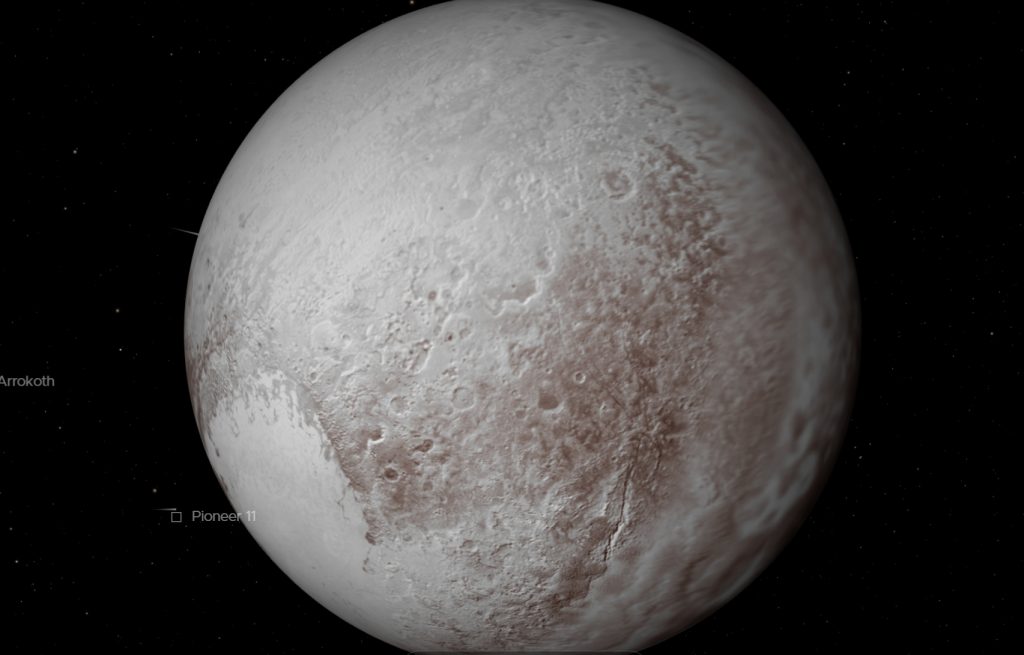
  • Surface Features: Pluto’s surface is characterized by a diverse range of features, including mountains, plains, and ice deposits. The most prominent surface features include the heart-shaped region known as Tombaugh Regio, which is composed primarily of nitrogen ice, and the Sputnik Planitia, a vast plain of nitrogen and methane ice.
  • Surface Composition: Pluto’s surface is primarily composed of a mixture of water ice, nitrogen ice, and methane ice. The varying compositions contribute to the planet’s colorful appearance, which ranges from white and gray to reddish-brown.

III. Atmosphere

1. Atmospheric Composition

  • Gases and Pressure: Pluto has a thin atmosphere composed mainly of nitrogen, with trace amounts of methane and carbon monoxide. The atmospheric pressure on Pluto is extremely low, about 1/100,000th of Earth’s atmospheric pressure at sea level.
  • Seasonal Changes: Pluto’s atmosphere undergoes significant seasonal changes due to its elliptical orbit. As Pluto moves closer to the Sun, the surface ice sublimates, creating a thicker atmosphere. Conversely, when Pluto is farther from the Sun, the atmosphere freezes back onto the surface.

2. Atmospheric Layers

  • Stratosphere and Thermosphere: The atmosphere of Pluto is divided into several layers, including the troposphere, stratosphere, and thermosphere. The stratosphere is characterized by the presence of methane ice clouds, while the thermosphere exhibits high temperatures due to the absorption of ultraviolet radiation.
  • Haze and Clouds: Pluto’s atmosphere contains a layer of haze, which is created by the interaction of sunlight with methane and other gases. The haze creates a pinkish tint in the atmosphere and contributes to the formation of transient clouds.

IV. Moons of Pluto

1. Charon

  • Discovery and Characteristics: Charon, Pluto’s largest moon, was discovered in 1978 by astronomer James Christy. It has a diameter of approximately 1,212 kilometers (754 miles) and is about half the size of Pluto. Charon’s surface is marked by a large canyon system and a dark region known as the Mordor Macula.
  • Orbital Dynamics: Charon and Pluto are tidally locked, meaning they always show the same face to each other. This synchronous rotation results in a unique binary system where both Pluto and Charon orbit a common center of mass outside Pluto.

2. Other Moons

  • Nix and Hydra: Nix and Hydra are two smaller moons of Pluto, discovered in 2005 by the Hubble Space Telescope. Nix has a diameter of about 45 kilometers (28 miles), while Hydra is slightly larger, with a diameter of about 65 kilometers (40 miles). Both moons are irregularly shaped and have highly elliptical orbits.
  • Kerberos and Styx: Kerberos and Styx are additional small moons of Pluto, discovered in 2011 and 2012, respectively. Kerberos has a diameter of about 19 kilometers (12 miles), and Styx has a diameter of about 16 kilometers (10 miles). Like Nix and Hydra, these moons have irregular shapes and orbits.

V. Exploration History

1. New Horizons Mission

  • Launch and Journey: The New Horizons spacecraft was launched on January 19, 2006, by NASA with the mission to explore Pluto and its moons. After a journey of nearly 10 years, New Horizons made its closest approach to Pluto on July 14, 2015.
  • Discoveries and Data: New Horizons provided the first detailed images and data of Pluto, revealing its complex surface features, atmospheric composition, and moons. Key discoveries included the discovery of vast plains of nitrogen ice, towering mountains of water ice, and the presence of a thin but dynamic atmosphere.
  • Extended Mission: After its successful flyby of Pluto, New Horizons continued its mission to explore other objects in the Kuiper Belt. It conducted a flyby of the Kuiper Belt object Arrokoth (formerly known as 2014 MU69) on January 1, 2019, providing additional data on the outer Solar System.

2. Future Missions

  • Proposed Missions: Various proposals have been made for future missions to Pluto and the Kuiper Belt. These missions could include orbiters, landers, and additional flybys to study Pluto in greater detail and explore other Kuiper Belt objects.
  • International Collaboration: Future exploration of Pluto may involve international collaboration, combining resources and expertise from multiple space agencies to conduct comprehensive studies of the dwarf planet and its environment.
VI. Scientific Significance

1. Kuiper Belt Studies

  • Understanding the Kuiper Belt: Pluto is a key object in the study of the Kuiper Belt, a region of the Solar System beyond Neptune that is populated with icy bodies and dwarf planets. Studying Pluto helps scientists understand the composition, formation, and evolution of the Kuiper Belt.
  • Comparison with Other Objects: Research on Pluto provides insights into the properties and dynamics of other Kuiper Belt objects. By comparing Pluto with other objects in the belt, scientists can learn more about the formation and evolution of the outer Solar System.

2. Planetary Science

  • Formation and Evolution: Pluto’s unique characteristics, including its composition, atmosphere, and moons, offer valuable insights into the processes that shaped the early Solar System. Studying Pluto helps scientists understand the formation and evolution of icy bodies and their interactions with other celestial objects.
  • Atmospheric Studies: Pluto’s thin atmosphere and seasonal changes provide a unique opportunity to study the dynamics of atmospheric processes on a small, distant world. Understanding these processes helps scientists learn more about the range of atmospheric phenomena in the Solar System.

3. Dwarf Planet Classification

  • Criteria and Debate: Pluto’s reclassification as a dwarf planet sparked significant debate within the scientific community. The decision was based on the criteria established by the International Astronomical Union (IAU), which defined a planet as a celestial body that orbits the Sun, is spherical in shape, and has cleared its orbit of other debris. Pluto did not meet the third criterion, leading to its reclassification as a dwarf planet.
  • Impact on Planetary Science: The reclassification of Pluto has implications for the study of other celestial objects in the Solar System. It has prompted discussions about the definition of planets and the criteria used to classify celestial bodies.

VII. Cultural and Historical Impact

1. Mythology and Naming

  • Naming: Pluto is named after the Roman god of the underworld, reflecting the tradition of naming celestial bodies after mythological figures. The name was suggested by Venetia Burney, an 11-year-old schoolgirl from England, and was chosen in part because it honored the work of the discoverer, Clyde Tombaugh, whose initials were represented in the name.
  • Popular Culture: Pluto has captured the public imagination and has been featured in various forms of popular culture

Tags: NASASpace ExplorationSpace technology
ShareTweetShare

Related Posts

Will AI Ever Truly Understand Human Consciousness?
AI

Will AI Ever Truly Understand Human Consciousness?

January 25, 2026
Can Cryptocurrency Replace Traditional Banking?
All Tech

Can Cryptocurrency Replace Traditional Banking?

January 25, 2026
Can Circular Economy Principles Revolutionize Healthcare?
All Tech

Can Circular Economy Principles Revolutionize Healthcare?

January 25, 2026
Can Innovation Thrive Without Government Funding?
All Tech

Can Innovation Thrive Without Government Funding?

January 25, 2026
Will We Ever Reach the Edge of the Observable Universe?
All Tech

Will We Ever Reach the Edge of the Observable Universe?

January 25, 2026
What Role Will AI Play in the Next Evolution of the Internet?
AI

What Role Will AI Play in the Next Evolution of the Internet?

January 24, 2026

Discussion about this post

  • Trending
  • Comments
  • Latest
Eternal Luminary: Humanity’s Perpetual Fascination with the Sun

Eternal Luminary: Humanity’s Perpetual Fascination with the Sun

November 5, 2024
The Race Heats Up: OpenAI Joins the AI-Powered Search Arena

The Race Heats Up: OpenAI Joins the AI-Powered Search Arena

October 16, 2024
The Canon DIGITAL IXUS Legacy: Redefining Photography with Style and Innovation

The Canon DIGITAL IXUS Legacy: Redefining Photography with Style and Innovation

November 2, 2024
A New Hope: Exploring KarXT’s Potential in Treating Alzheimer’s-Related Psychosis

A New Hope: Exploring KarXT’s Potential in Treating Alzheimer’s-Related Psychosis

December 5, 2024
The Lunar Symphony: Hal Clement’s Prophetic Fantasia

The Lunar Symphony: Hal Clement’s Prophetic Fantasia

Unlocking the Future with AI’s Latest Breakthroughs: A Journey into the Unchartered Frontier

Unlocking the Future with AI’s Latest Breakthroughs: A Journey into the Unchartered Frontier

The Transformative Power of Machine Learning: Shaping the Future of Technology and Beyond

The Transformative Power of Machine Learning: Shaping the Future of Technology and Beyond

The Emotional Intelligence of AI: Bridging the Gap Between Machines and Hearts

The Emotional Intelligence of AI: Bridging the Gap Between Machines and Hearts

Will AI Ever Truly Understand Human Consciousness?

Will AI Ever Truly Understand Human Consciousness?

January 25, 2026
Can Cryptocurrency Replace Traditional Banking?

Can Cryptocurrency Replace Traditional Banking?

January 25, 2026
Can Circular Economy Principles Revolutionize Healthcare?

Can Circular Economy Principles Revolutionize Healthcare?

January 25, 2026
Can Innovation Thrive Without Government Funding?

Can Innovation Thrive Without Government Funding?

January 25, 2026
techfusionnews

Discover the essence of innovation at "Tech Aggregator," where the latest in tech converges. From cutting-edge gadgets to cosmic ventures and green breakthroughs, our site offers a streamlined look at the future of technology. Engage with concise, impactful content designed for those eager to stay ahead in an ever-evolving digital landscape. Join us at the forefront of the tech revolution.

© 2025 techfusionnews.com. contacts:[email protected]

No Result
View All Result
  • Home
  • Digital Lifestyle
  • Green Tech & Wellness
  • AI
  • Space Exploration
  • Innovation & Research
  • All Tech

© 2025 techfusionnews.com. contacts:[email protected]

Welcome Back!

Login to your account below

Forgotten Password?

Retrieve your password

Please enter your username or email address to reset your password.

Log In