














techfusionnews
  • Home
  • Digital Lifestyle
    Can Cryptocurrency Replace Traditional Banking?

    Can Cryptocurrency Replace Traditional Banking?

    Is Augmented Reality Changing How We Learn?

    Is Augmented Reality Changing How We Learn?

    The Dark Side of the Smart City Revolution

    The Dark Side of the Smart City Revolution

    Can You Escape the Surveillance State with VPNs?

    Can You Escape the Surveillance State with VPNs?

    Are Digital Detoxes Just a Trend or a Necessity?

    Are Digital Detoxes Just a Trend or a Necessity?

    Is Social Media Helping or Hurting Your Mental Health?

    Is Social Media Helping or Hurting Your Mental Health?

  • Green Tech & Wellness
    Can Circular Economy Principles Revolutionize Healthcare?

    Can Circular Economy Principles Revolutionize Healthcare?

    Is AI the Secret to Personalized Eco-Wellness Solutions?

    Is AI the Secret to Personalized Eco-Wellness Solutions?

    How Do Green Building Materials Affect Your Overall Wellbeing?

    How Do Green Building Materials Affect Your Overall Wellbeing?

    Could Plant-Based Diets Be the Future of Eco-Friendly Wellness?

    Could Plant-Based Diets Be the Future of Eco-Friendly Wellness?

    How Can Smart Green Gadgets Improve Indoor Air Quality?

    How Can Smart Green Gadgets Improve Indoor Air Quality?

    Can Clean Energy Revolutionize Your Fitness Routine?

    Can Clean Energy Revolutionize Your Fitness Routine?

  • AI
    Will AI Ever Truly Understand Human Consciousness?

    Will AI Ever Truly Understand Human Consciousness?

    What Role Will AI Play in the Next Evolution of the Internet?

    What Role Will AI Play in the Next Evolution of the Internet?

    How Will AI Transform the Future of Education?

    How Will AI Transform the Future of Education?

    Can AI Understand and Create Humor?

    Can AI Understand and Create Humor?

    Is AI the Key to Unlocking Human Potential?

    Is AI the Key to Unlocking Human Potential?

    How Close Are We to AI Becoming Sentient?

    How Close Are We to AI Becoming Sentient?

  • Space Exploration
    Will We Ever Reach the Edge of the Observable Universe?

    Will We Ever Reach the Edge of the Observable Universe?

    What Are the Ethical Implications of Colonizing Other Planets?

    What Are the Ethical Implications of Colonizing Other Planets?

    What If Earth’s Magnetic Field Collapsed—Could We Survive in Space?

    What If Earth’s Magnetic Field Collapsed—Could We Survive in Space?

    Can Artificial Intelligence Assist in Discovering Exoplanets?

    Can Artificial Intelligence Assist in Discovering Exoplanets?

    Is Space Debris a Threat to Future Space Exploration?

    Is Space Debris a Threat to Future Space Exploration?

    Could We Use Wormholes to Travel Through Time and Space?

    Could We Use Wormholes to Travel Through Time and Space?

  • Innovation & Research
    Can Innovation Thrive Without Government Funding?

    Can Innovation Thrive Without Government Funding?

    Are We Ready for the Ethical Challenges of AI in Research?

    Are We Ready for the Ethical Challenges of AI in Research?

    How Can Failure Be the Most Important Lesson in Innovation?

    How Can Failure Be the Most Important Lesson in Innovation?

    Can the Digital Transformation of Research Lead to Global Scientific Unity?

    Can the Digital Transformation of Research Lead to Global Scientific Unity?

    What is the True Value of Interdisciplinary Research in Innovation?

    Why Do Some Scientific Discoveries Fail to Make an Impact?

    Why Do Some Scientific Discoveries Fail to Make an Impact?

  • All Tech
    Will AI Ever Truly Understand Human Consciousness?

    Will AI Ever Truly Understand Human Consciousness?

    Can Cryptocurrency Replace Traditional Banking?

    Can Cryptocurrency Replace Traditional Banking?

    Can Circular Economy Principles Revolutionize Healthcare?

    Can Circular Economy Principles Revolutionize Healthcare?

    Can Innovation Thrive Without Government Funding?

    Can Innovation Thrive Without Government Funding?

    Will We Ever Reach the Edge of the Observable Universe?

    Will We Ever Reach the Edge of the Observable Universe?

    What Role Will AI Play in the Next Evolution of the Internet?

    What Role Will AI Play in the Next Evolution of the Internet?

techfusionnews
  • Home
  • Digital Lifestyle
    Can Cryptocurrency Replace Traditional Banking?

    Can Cryptocurrency Replace Traditional Banking?

    Is Augmented Reality Changing How We Learn?

    Is Augmented Reality Changing How We Learn?

    The Dark Side of the Smart City Revolution

    The Dark Side of the Smart City Revolution

    Can You Escape the Surveillance State with VPNs?

    Can You Escape the Surveillance State with VPNs?

    Are Digital Detoxes Just a Trend or a Necessity?

    Are Digital Detoxes Just a Trend or a Necessity?

    Is Social Media Helping or Hurting Your Mental Health?

    Is Social Media Helping or Hurting Your Mental Health?

  • Green Tech & Wellness
    Can Circular Economy Principles Revolutionize Healthcare?

    Can Circular Economy Principles Revolutionize Healthcare?

    Is AI the Secret to Personalized Eco-Wellness Solutions?

    Is AI the Secret to Personalized Eco-Wellness Solutions?

    How Do Green Building Materials Affect Your Overall Wellbeing?

    How Do Green Building Materials Affect Your Overall Wellbeing?

    Could Plant-Based Diets Be the Future of Eco-Friendly Wellness?

    Could Plant-Based Diets Be the Future of Eco-Friendly Wellness?

    How Can Smart Green Gadgets Improve Indoor Air Quality?

    How Can Smart Green Gadgets Improve Indoor Air Quality?

    Can Clean Energy Revolutionize Your Fitness Routine?

    Can Clean Energy Revolutionize Your Fitness Routine?

  • AI
    Will AI Ever Truly Understand Human Consciousness?

    Will AI Ever Truly Understand Human Consciousness?

    What Role Will AI Play in the Next Evolution of the Internet?

    What Role Will AI Play in the Next Evolution of the Internet?

    How Will AI Transform the Future of Education?

    How Will AI Transform the Future of Education?

    Can AI Understand and Create Humor?

    Can AI Understand and Create Humor?

    Is AI the Key to Unlocking Human Potential?

    Is AI the Key to Unlocking Human Potential?

    How Close Are We to AI Becoming Sentient?

    How Close Are We to AI Becoming Sentient?

  • Space Exploration
    Will We Ever Reach the Edge of the Observable Universe?

    Will We Ever Reach the Edge of the Observable Universe?

    What Are the Ethical Implications of Colonizing Other Planets?

    What Are the Ethical Implications of Colonizing Other Planets?

    What If Earth’s Magnetic Field Collapsed—Could We Survive in Space?

    What If Earth’s Magnetic Field Collapsed—Could We Survive in Space?

    Can Artificial Intelligence Assist in Discovering Exoplanets?

    Can Artificial Intelligence Assist in Discovering Exoplanets?

    Is Space Debris a Threat to Future Space Exploration?

    Is Space Debris a Threat to Future Space Exploration?

    Could We Use Wormholes to Travel Through Time and Space?

    Could We Use Wormholes to Travel Through Time and Space?

  • Innovation & Research
    Can Innovation Thrive Without Government Funding?

    Can Innovation Thrive Without Government Funding?

    Are We Ready for the Ethical Challenges of AI in Research?

    Are We Ready for the Ethical Challenges of AI in Research?

    How Can Failure Be the Most Important Lesson in Innovation?

    How Can Failure Be the Most Important Lesson in Innovation?

    Can the Digital Transformation of Research Lead to Global Scientific Unity?

    Can the Digital Transformation of Research Lead to Global Scientific Unity?

    What is the True Value of Interdisciplinary Research in Innovation?

    Why Do Some Scientific Discoveries Fail to Make an Impact?

    Why Do Some Scientific Discoveries Fail to Make an Impact?

  • All Tech
    Will AI Ever Truly Understand Human Consciousness?

    Will AI Ever Truly Understand Human Consciousness?

    Can Cryptocurrency Replace Traditional Banking?

    Can Cryptocurrency Replace Traditional Banking?

    Can Circular Economy Principles Revolutionize Healthcare?

    Can Circular Economy Principles Revolutionize Healthcare?

    Can Innovation Thrive Without Government Funding?

    Can Innovation Thrive Without Government Funding?

    Will We Ever Reach the Edge of the Observable Universe?

    Will We Ever Reach the Edge of the Observable Universe?

    What Role Will AI Play in the Next Evolution of the Internet?

    What Role Will AI Play in the Next Evolution of the Internet?

No Result
View All Result
Plugin Install : Cart Icon need WooCommerce plugin to be installed.
techfusionnews
No Result
View All Result
Home Innovation & Research

Can AI Revolutionize the Future of Scientific Research?

November 26, 2025
in Innovation & Research

Introduction

In recent years, the integration of Artificial Intelligence (AI) into various domains has stirred excitement, and perhaps nowhere is the promise of AI more potent than in scientific research. The rise of AI offers new possibilities for enhancing our capacity to explore, understand, and manipulate the natural world. Its potential to speed up data analysis, uncover new patterns, and simulate complex systems opens up new frontiers in research that were previously unimaginable. But the question remains: Can AI truly revolutionize the future of scientific research?

As we navigate this question, we must examine the many facets in which AI is already playing a role in science, the challenges researchers face, and the transformative potential AI holds for accelerating breakthroughs in diverse fields such as biology, chemistry, physics, and environmental science.

The Role of AI in Modern Research

Data Analysis and Pattern Recognition

One of the most significant challenges in contemporary scientific research is the sheer volume of data being generated. From high-resolution imaging in biology to large-scale data sets in astronomy, the amount of information available to researchers is overwhelming. Traditional data analysis methods often fall short in handling the complexity and size of this data. AI, especially machine learning (ML) algorithms, excels in processing massive data sets at speeds far beyond human capabilities.

AI algorithms can sift through these large volumes of data, identify patterns, and make predictions. For example, in genomics, AI has been used to analyze DNA sequences, identify mutations, and predict genetic diseases. In climate science, AI helps in predicting weather patterns and modeling climate change scenarios, which would take humans decades to compute manually. These applications demonstrate AI’s ability to uncover insights from data that would otherwise remain hidden, accelerating research across multiple domains.

Accelerating Drug Discovery

One area where AI is already having a profound impact is in drug discovery. Traditional drug development is a time-consuming, expensive, and often inefficient process. It can take years—sometimes decades—for a drug to go from concept to clinical trials. However, AI has the potential to significantly shorten this timeline by rapidly analyzing biological data and predicting how different compounds will interact with specific proteins or receptors in the body.

AI models can also predict adverse drug reactions, optimize the design of clinical trials, and identify new drug candidates that may have been overlooked by human researchers. For instance, in the fight against COVID-19, AI played a pivotal role in rapidly identifying potential antiviral compounds, expediting the development of vaccines and therapies. The ability to simulate and test drug interactions at a molecular level using AI algorithms not only speeds up research but also makes it more cost-effective and precise.

Enhancing Scientific Simulations

The realm of scientific simulations has seen a massive transformation due to AI. Whether in particle physics, cosmology, or climate modeling, simulations are essential for testing hypotheses and exploring uncharted territories. AI algorithms can significantly enhance the precision of these simulations, incorporating complex variables and providing more accurate predictions.

In particle physics, for instance, AI is being used to simulate the behavior of subatomic particles under extreme conditions, such as those found in particle accelerators. AI can predict the outcomes of experiments with remarkable accuracy, helping scientists refine their understanding of fundamental forces and particles.
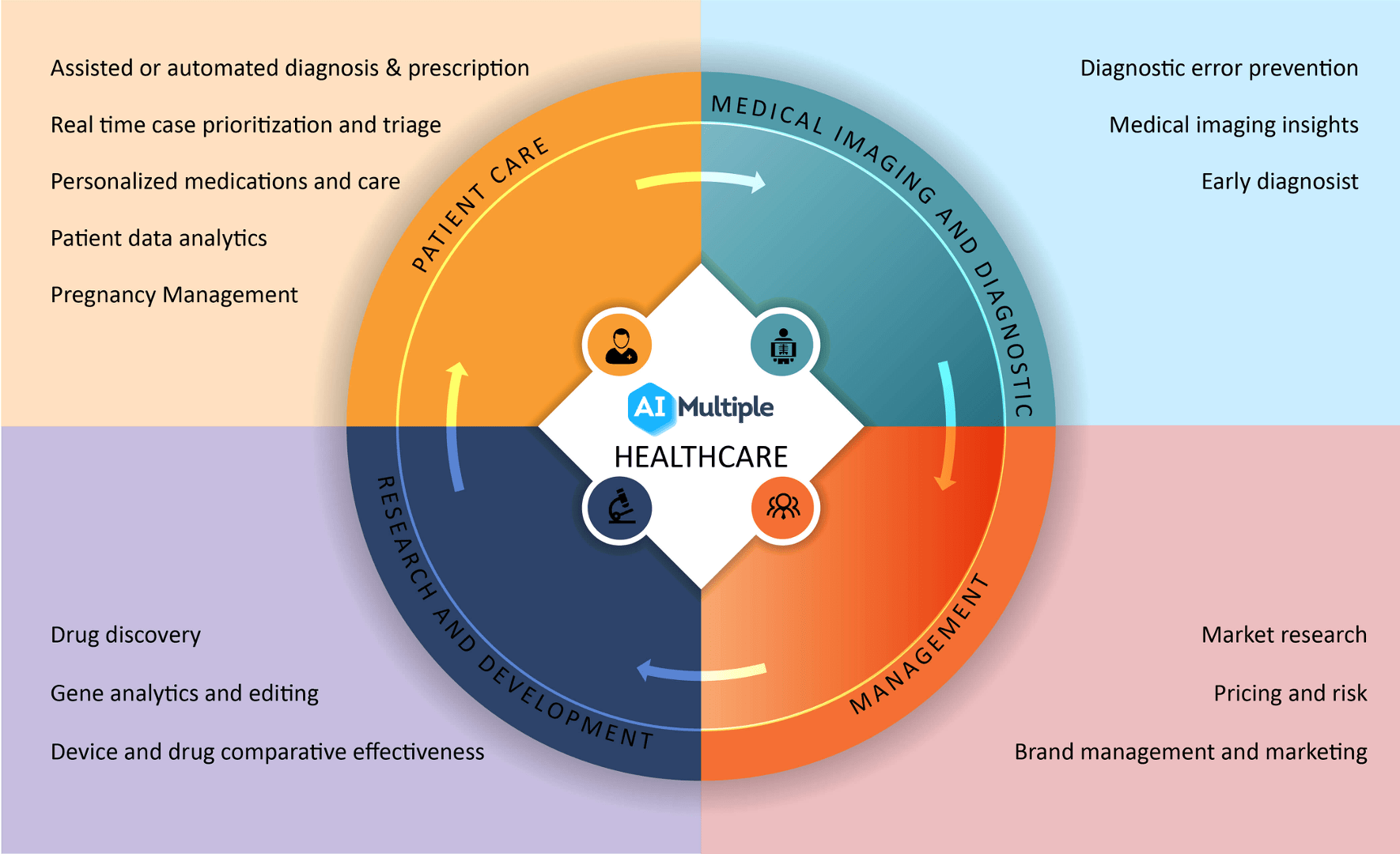
Ai And Ml Applications In Healthcare Machine Learning Healthcare  Applications 2025

Moreover, AI-powered simulations in environmental science can predict the long-term impacts of human activities on ecosystems, guiding policy decisions and conservation efforts. The capability to simulate real-world phenomena with AI-driven precision could accelerate solutions to some of humanity’s most pressing challenges, such as climate change and biodiversity loss.

The Impact of AI on Various Scientific Disciplines

Biology and Medicine

The use of AI in biological and medical research is perhaps the most immediate and transformative. From diagnostic tools to personalized treatment regimens, AI is enhancing the efficiency and accuracy of medical practice. Machine learning models trained on vast amounts of patient data can assist in diagnosing diseases, predicting outcomes, and recommending treatment plans tailored to individual patients.

AI is also playing a crucial role in personalized medicine, where treatment plans are based on the genetic makeup and specific health conditions of patients. For example, AI can identify patterns in patients’ genomes that indicate susceptibility to certain diseases or predict how they will respond to different medications. This ability to tailor treatments to individual needs is revolutionizing how we approach healthcare.

Furthermore, AI is transforming biological research by automating repetitive laboratory tasks. Researchers can now use AI to control experimental setups, analyze results, and optimize workflows, freeing up more time for creative and critical thinking. This shift in how research is conducted promises to streamline the entire research process, making it faster, more efficient, and more reliable.

Chemistry

AI’s impact on chemistry is also profound, especially in the areas of material science and molecular chemistry. By using machine learning algorithms, researchers can predict the properties of new materials before they are synthesized in the lab. This ability to predict material properties based on their atomic and molecular structure could lead to the rapid development of novel materials for applications in energy storage, electronics, and even quantum computing.

For example, AI models can predict the conductivity, strength, and other properties of new polymers or compounds, significantly reducing the trial-and-error approach traditionally employed in chemistry. This can accelerate the development of innovative materials for use in batteries, semiconductors, and renewable energy technologies, all of which are vital for future technological advancements.

Physics and Astronomy

In physics, AI is playing a critical role in data-driven research, especially in areas such as quantum mechanics, cosmology, and high-energy particle physics. Large-scale experiments like those conducted at CERN’s Large Hadron Collider generate enormous amounts of data that need to be processed and analyzed to discover new particles or phenomena. AI is invaluable in helping physicists sift through this data quickly and accurately.

In astronomy, AI-powered tools are used to analyze massive datasets generated by telescopes, identifying potential exoplanets, supernovae, or black holes that might otherwise go unnoticed. With the upcoming generation of space telescopes, AI will become even more critical in helping astronomers process and interpret data from distant galaxies, offering new insights into the origins of the universe.

What are the current challenges of drug discovery? - Lifebit

Environmental Science and Sustainability

AI is also transforming environmental science by enabling more accurate predictions of climate change, biodiversity loss, and ecosystem dynamics. Machine learning algorithms can analyze satellite images, environmental sensor data, and historical climate data to predict future trends and assess the impact of human activities on the environment.

For instance, AI can be used to monitor deforestation in real time, helping to protect vulnerable ecosystems and inform conservation efforts. Similarly, AI-driven models can predict the effects of climate change on water resources, crop yields, and biodiversity, providing policymakers with data-driven insights to make more informed decisions.

In addition, AI can optimize energy consumption, leading to more efficient use of resources and reduced carbon emissions. In the renewable energy sector, AI can improve the efficiency of wind turbines, solar panels, and battery storage systems by continuously analyzing performance data and adjusting systems to optimize output.

Challenges and Ethical Considerations

While the potential for AI to revolutionize scientific research is immense, several challenges and ethical considerations need to be addressed. One of the primary concerns is the transparency and interpretability of AI algorithms. Many machine learning models, particularly deep learning networks, operate as “black boxes,” making it difficult for researchers to understand how they arrive at their conclusions. This lack of transparency can be problematic, especially in critical fields like medicine, where trust and accountability are paramount.

Another issue is the potential for bias in AI models. Machine learning algorithms are only as good as the data they are trained on, and if the data is biased or incomplete, the predictions made by the AI may be flawed. In medical research, for example, if an AI system is trained on data that predominantly reflects one demographic group, it may not perform well when applied to other groups, leading to disparities in healthcare outcomes.

Finally, there are concerns about the ethical implications of AI in research. As AI systems become more autonomous, questions arise about the role of human oversight in the research process. Will AI replace human researchers, or will it serve as a tool to enhance their capabilities? And as AI becomes more integrated into decision-making processes, who is responsible when something goes wrong?

The Future of AI in Scientific Research

Looking ahead, the future of AI in scientific research holds great promise. As AI algorithms become more advanced and accessible, researchers will be able to tackle increasingly complex problems with greater precision and efficiency. AI’s ability to simulate, predict, and analyze data at scale will continue to transform how science is conducted, opening up new avenues for discovery and innovation.

In particular, AI’s potential to foster interdisciplinary collaboration could revolutionize how different fields of science interact. Researchers in biology, physics, and chemistry could use AI-driven platforms to share data and insights, enabling faster cross-disciplinary breakthroughs. AI could act as the universal translator, bridging gaps between different scientific disciplines and facilitating collaborative problem-solving on a global scale.

Moreover, the integration of AI with other emerging technologies, such as quantum computing and robotics, could further accelerate research and development in ways we can only begin to imagine. The combination of AI’s data-processing power with quantum computing’s ability to simulate complex systems could lead to breakthroughs in areas such as material science, drug discovery, and climate modeling.

Conclusion

AI is already transforming the landscape of scientific research, and its potential to revolutionize the future is undeniable. From accelerating drug discovery to enhancing environmental monitoring, AI offers solutions to some of the most pressing challenges facing science and society today. However, the path forward is not without challenges. Ethical concerns, biases, and the need for human oversight must be carefully addressed to ensure that AI remains a force for good in research.

As AI continues to evolve, it will undoubtedly unlock new possibilities for scientific discovery, enabling researchers to explore uncharted territories, solve complex problems, and make breakthroughs that will shape the future of humanity. The integration of AI into scientific research is not just a trend—it is the beginning of a new era in science, one in which AI plays a central role in shaping the discoveries of tomorrow.


Tags: AI InnovationMachine LearningResearchTechnology
ShareTweetShare

Related Posts

Can Innovation Thrive Without Government Funding?
All Tech

Can Innovation Thrive Without Government Funding?

January 25, 2026
Are We Ready for the Ethical Challenges of AI in Research?
All Tech

Are We Ready for the Ethical Challenges of AI in Research?

January 24, 2026
How Can Failure Be the Most Important Lesson in Innovation?
All Tech

How Can Failure Be the Most Important Lesson in Innovation?

January 23, 2026
Can the Digital Transformation of Research Lead to Global Scientific Unity?
All Tech

Can the Digital Transformation of Research Lead to Global Scientific Unity?

January 22, 2026
All Tech

What is the True Value of Interdisciplinary Research in Innovation?

January 21, 2026
Why Do Some Scientific Discoveries Fail to Make an Impact?
All Tech

Why Do Some Scientific Discoveries Fail to Make an Impact?

January 20, 2026

Discussion about this post

  • Trending
  • Comments
  • Latest
Eternal Luminary: Humanity’s Perpetual Fascination with the Sun

Eternal Luminary: Humanity’s Perpetual Fascination with the Sun

November 5, 2024
The Race Heats Up: OpenAI Joins the AI-Powered Search Arena

The Race Heats Up: OpenAI Joins the AI-Powered Search Arena

October 16, 2024
The Canon DIGITAL IXUS Legacy: Redefining Photography with Style and Innovation

The Canon DIGITAL IXUS Legacy: Redefining Photography with Style and Innovation

November 2, 2024
A New Hope: Exploring KarXT’s Potential in Treating Alzheimer’s-Related Psychosis

A New Hope: Exploring KarXT’s Potential in Treating Alzheimer’s-Related Psychosis

December 5, 2024
The Lunar Symphony: Hal Clement’s Prophetic Fantasia

The Lunar Symphony: Hal Clement’s Prophetic Fantasia

Unlocking the Future with AI’s Latest Breakthroughs: A Journey into the Unchartered Frontier

Unlocking the Future with AI’s Latest Breakthroughs: A Journey into the Unchartered Frontier

The Transformative Power of Machine Learning: Shaping the Future of Technology and Beyond

The Transformative Power of Machine Learning: Shaping the Future of Technology and Beyond

The Emotional Intelligence of AI: Bridging the Gap Between Machines and Hearts

The Emotional Intelligence of AI: Bridging the Gap Between Machines and Hearts

Will AI Ever Truly Understand Human Consciousness?

Will AI Ever Truly Understand Human Consciousness?

January 25, 2026
Can Cryptocurrency Replace Traditional Banking?

Can Cryptocurrency Replace Traditional Banking?

January 25, 2026
Can Circular Economy Principles Revolutionize Healthcare?

Can Circular Economy Principles Revolutionize Healthcare?

January 25, 2026
Can Innovation Thrive Without Government Funding?

Can Innovation Thrive Without Government Funding?

January 25, 2026
techfusionnews

Discover the essence of innovation at "Tech Aggregator," where the latest in tech converges. From cutting-edge gadgets to cosmic ventures and green breakthroughs, our site offers a streamlined look at the future of technology. Engage with concise, impactful content designed for those eager to stay ahead in an ever-evolving digital landscape. Join us at the forefront of the tech revolution.

© 2025 techfusionnews.com. contacts:[email protected]

No Result
View All Result
  • Home
  • Digital Lifestyle
  • Green Tech & Wellness
  • AI
  • Space Exploration
  • Innovation & Research
  • All Tech

© 2025 techfusionnews.com. contacts:[email protected]

Welcome Back!

Login to your account below

Forgotten Password?

Retrieve your password

Please enter your username or email address to reset your password.

Log In