






















Introduction: The Intelligence Revolution
Throughout history, humanity has been defined by its ability to create tools. From the invention of the wheel to the development of the internet, each technological leap has expanded human capability. Today, we stand at the beginning of another transformation—one driven not by physical tools, but by intelligence itself.
Artificial Intelligence (AI) is no longer a futuristic concept. It is embedded in our daily lives—powering recommendation systems, enabling voice assistants, optimizing logistics, and even generating creative content. What makes AI fundamentally different from previous technologies is its ability to perform tasks that traditionally required human cognition.
We are not just building machines that work for us—we are building machines that can think, learn, and adapt.
This shift raises profound questions:
- What is intelligence?
- What roles will humans play in an AI-driven world?
- How will society adapt to systems that can outperform humans in certain domains?
This article explores the transformative impact of AI across industries, its implications for human identity, and the challenges we must navigate as we enter the age of intelligent machines.
1. Defining Artificial Intelligence: Beyond the Buzzword
1.1 What Is AI?
Artificial Intelligence refers to systems designed to perform tasks that typically require human intelligence. These tasks include:
- Learning from data
- Recognizing patterns
- Making decisions
- Understanding language
- Solving problems
AI is not a single technology, but a collection of approaches and methodologies.
1.2 Narrow AI vs General AI
Most AI systems today are narrow AI, meaning they are designed for specific tasks. Examples include:
- Image recognition
- Language translation
- Recommendation algorithms
Artificial General Intelligence (AGI), on the other hand, refers to systems capable of performing any intellectual task that a human can do. While AGI remains theoretical, it represents a major focus of research.
1.3 Machine Learning and Deep Learning
Modern AI is largely driven by machine learning, where systems learn from data rather than being explicitly programmed.
Deep learning, a subset of machine learning, uses neural networks with multiple layers to model complex patterns. These systems have achieved breakthroughs in:
- Computer vision
- Natural language processing
- Speech recognition
2. AI Across Industries: A Universal Disruptor
2.1 Healthcare
AI is transforming healthcare in several ways:
- Early disease detection through medical imaging
- Personalized treatment plans
- Drug discovery acceleration
AI systems can analyze vast datasets, identifying patterns that may be invisible to human doctors.
2.2 Finance
In finance, AI is used for:
- Fraud detection
- Algorithmic trading
- Risk assessment
These systems operate at speeds and scales beyond human capability.
2.3 Transportation
Autonomous vehicles represent one of the most visible applications of AI. These systems rely on:
- Computer vision
- Sensor fusion
- Real-time decision-making
2.4 Creative Industries
AI is now capable of generating:
- Art
- Music
- Writing
- Video content
This challenges traditional notions of creativity and authorship.
3. The Future of Work: Automation and Augmentation
3.1 Job Displacement
One of the most discussed impacts of AI is job automation. Tasks that are repetitive or predictable are particularly vulnerable.
Examples include:
- Data entry
- Manufacturing processes
- Customer support
3.2 Job Creation
At the same time, AI is creating new roles:
- AI engineers
- Data scientists
- Ethics specialists
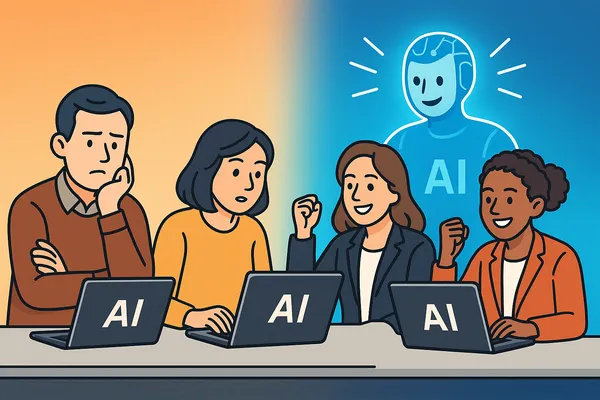
3.3 Human-AI Collaboration
Rather than replacing humans entirely, AI is more likely to augment human capabilities.
In many fields, the most effective approach is a combination of human intuition and machine precision.
4. Intelligence Redefined: What Makes Us Human?
4.1 Cognitive vs Emotional Intelligence
AI excels at logical and data-driven tasks, but struggles with:
- Emotional understanding
- Contextual nuance
- Moral reasoning
4.2 Creativity in the Age of AI
AI-generated content raises questions:
- Is creativity uniquely human?
- Can machines truly “create”?
4.3 Consciousness and Awareness
Current AI systems do not possess consciousness. They simulate intelligence without subjective experience.
5. Ethical Challenges of AI
5.1 Bias and Fairness
AI systems can inherit biases from training data, leading to unfair outcomes.
5.2 Privacy Concerns
AI relies heavily on data, raising issues about:
- Surveillance
- Data ownership
- Consent
5.3 Accountability
When AI systems make decisions, who is responsible?
6. AI and Society: A Structural Shift
6.1 Economic Impact
AI has the potential to:
- Increase productivity
- Concentrate wealth
- Disrupt labor markets
6.2 Education and Skills
Education systems must adapt to prepare individuals for an AI-driven world.
6.3 Governance and Regulation
Governments are working to establish frameworks to ensure safe and ethical AI deployment.
7. The Path to Artificial General Intelligence
7.1 Current Limitations
AI systems lack:
- General reasoning
- Common sense
- Transfer learning capabilities
7.2 Research Directions
Efforts toward AGI focus on:
- Multimodal learning
- Reinforcement learning
- Neural-symbolic integration
7.3 Risks and Opportunities
AGI could:
- Solve complex global challenges
- Introduce unprecedented risks
8. The Future: Coexisting with Intelligent Machines
8.1 A Hybrid Intelligence World
The future may involve a blend of human and machine intelligence.
8.2 AI as a Tool vs AI as an Agent
Will AI remain a tool, or become an independent actor?
8.3 Long-Term Vision
AI could reshape civilization in ways we are only beginning to understand.
Conclusion: A Defining Moment for Humanity
Artificial Intelligence is not just another technological advancement—it is a transformation of intelligence itself.
As we develop increasingly powerful systems, we must decide how they are used, who benefits, and what values they reflect.
The future of AI is not predetermined. It will be shaped by the choices we make today.










Discussion about this post