






























Introduction
For thousands of years, humanity has looked into the night sky and wondered one profound question:
Are we alone in the universe?
Ancient civilizations created myths about celestial beings and divine worlds beyond Earth. Philosophers debated whether other inhabited worlds might exist among the stars. With the rise of modern astronomy, the question evolved from philosophy into science. Telescopes revealed that Earth is only one planet orbiting one ordinary star in a galaxy containing hundreds of billions of stars. Modern science now estimates that the observable universe may contain trillions of galaxies.
The sheer scale of the cosmos makes the possibility of extraterrestrial life difficult to ignore.
Advances in space exploration, planetary science, artificial intelligence, and astronomical observation have transformed the search for alien life into one of humanity’s most important scientific endeavors. Scientists now search for habitable planets, chemical biosignatures, radio signals, and microbial traces that might reveal life beyond Earth.
The search for extraterrestrial life is not simply about discovering aliens. It touches fundamental questions about:
- Human identity
- Evolution
- Consciousness
- Religion
- Civilization
- Humanity’s place in the universe
Finding even microbial life elsewhere would permanently alter humanity’s understanding of existence.
This article explores the scientific search for alien life, the technologies enabling exploration, the conditions required for life, the possibility of intelligent civilizations, the challenges of interstellar communication, and how the discovery of extraterrestrial life could reshape human civilization forever.
Humanity’s Historical Fascination with Alien Worlds
Ancient Beliefs About the Cosmos
Ancient cultures often imagined celestial beings living in the heavens.
Stars and planets were associated with:
- Gods
- Spirits
- Supernatural worlds
Although these ideas were not scientific, they reflected humanity’s long-standing curiosity about life beyond Earth.
The Scientific Revolution
The development of astronomy transformed humanity’s understanding of the universe.
Scientists such as:
- Copernicus
- Galileo
- Kepler
showed that Earth is not the center of the cosmos.
This realization opened the possibility that other planets might resemble Earth.
Modern Astrobiology
Today, the scientific study of life in the universe is known as astrobiology.
Astrobiologists combine:
- Biology
- Astronomy
- Chemistry
- Planetary science
to study how life might emerge and survive beyond Earth.
What Makes a Planet Habitable?
The Importance of Water
Liquid water is considered one of the most important conditions for life as humans understand it.
Water supports:
- Chemical reactions
- Nutrient transport
- Cellular processes
Scientists therefore search for planets with potential liquid water environments.
The Habitable Zone
A habitable zone refers to the region around a star where temperatures may allow liquid water to exist.
Planets too close to stars become extremely hot, while planets too far away may freeze completely.
Atmosphere and Climate
A stable atmosphere helps regulate temperature and protect life from harmful radiation.
Important atmospheric components may include:
- Oxygen
- Carbon dioxide
- Nitrogen
- Methane
Atmospheric analysis is a major focus of exoplanet research.
Energy Sources
Life requires energy.
Potential extraterrestrial energy sources include:
- Sunlight
- Chemical reactions
- Geothermal activity
Even environments without sunlight may potentially support microbial ecosystems.
Exoplanets and the Discovery of New Worlds
What Are Exoplanets?
Exoplanets are planets orbiting stars outside our solar system.
The first confirmed exoplanet discoveries revolutionized astronomy.
Scientists now know that planetary systems are common throughout the galaxy.
Thousands of Planet Discoveries
Modern telescopes have identified thousands of exoplanets with enormous diversity:
- Gas giants
- Rocky Earth-like planets
- Ocean worlds
- Super-Earths
Some may possess conditions suitable for life.
Earth-Like Worlds
Scientists focus heavily on rocky planets within habitable zones.
Potentially habitable exoplanets generate significant scientific interest because they may support:
- Liquid water
- Stable climates
- Biological chemistry
Future Planetary Observation
Advanced telescopes may eventually analyze:
- Atmospheric composition
- Weather patterns
- Biosignatures
Scientists hope to identify chemical evidence of life remotely.
Life Within Our Solar System
Mars
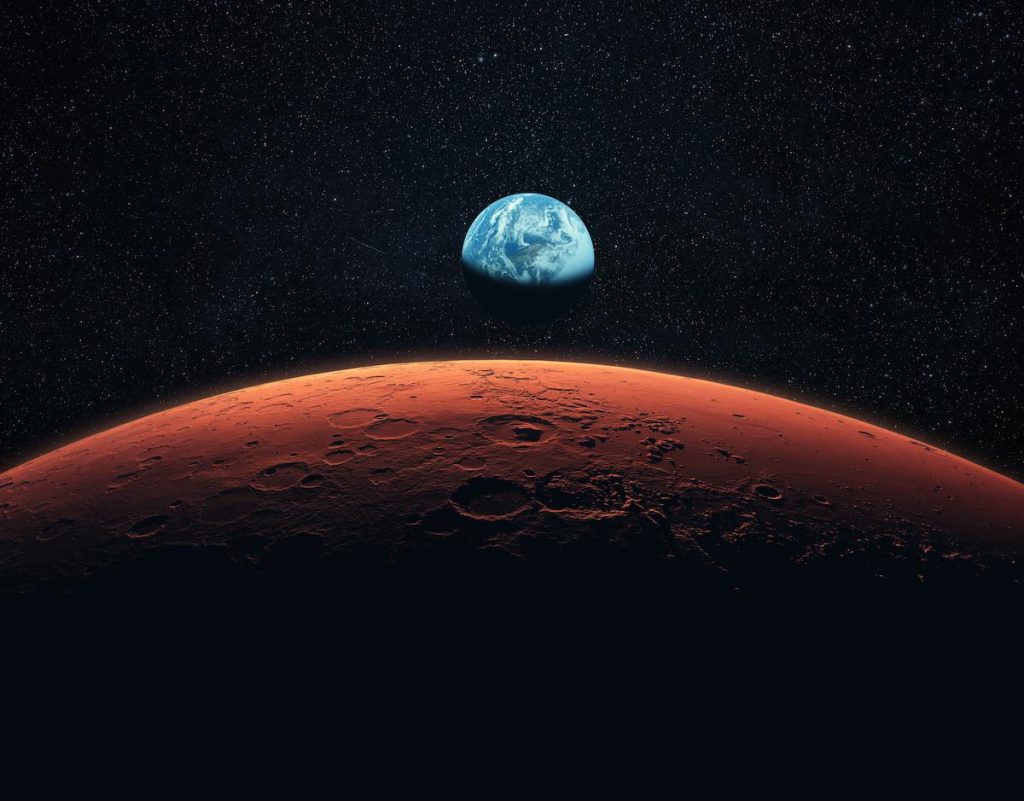
Mars remains one of the most important targets in the search for extraterrestrial life.
Evidence suggests ancient Mars once possessed:
- Rivers
- Lakes
- Possibly oceans
Scientists continue searching for:
- Fossilized microbes
- Underground water
- Organic molecules
Europa
Europa, one of Jupiter’s moons, contains a massive subsurface ocean beneath icy crust.
Scientists believe hydrothermal activity may exist beneath the surface.
This environment could potentially support microbial life.
Enceladus
Saturn’s moon Enceladus ejects water vapor and organic materials into space through icy geysers.
This suggests internal oceans and chemical activity.
Titan
Titan possesses:
- Thick atmosphere
- Hydrocarbon lakes
- Complex chemistry
Although extremely cold, Titan may reveal alternative forms of prebiotic chemistry.
The Possibility of Intelligent Alien Civilizations
The Drake Equation
Astronomer Frank Drake proposed an equation estimating the number of communicative civilizations in the galaxy.
The equation considers factors such as:
- Star formation
- Planet frequency
- Development of intelligence
- Technological lifespan
Although uncertain, the equation frames scientific discussion about intelligent life.
The Fermi Paradox
Physicist Enrico Fermi famously asked:
“If extraterrestrial civilizations are common, where is everybody?”
This contradiction between probable alien existence and lack of evidence is known as the Fermi Paradox.
Possible Explanations
Potential explanations include:
- Intelligent life is extremely rare
- Civilizations self-destruct
- Communication distances are too vast
- Humans are searching incorrectly
The paradox remains unresolved.
Searching for Signals from Space
SETI
The Search for Extraterrestrial Intelligence (SETI) analyzes radio signals from space in hopes of detecting artificial communication.
Scientists search for:
- Repeating patterns
- Non-natural transmissions
- Technological signatures
Radio Astronomy
Radio waves travel enormous distances through space.
Advanced civilizations might use radio communication because it is detectable across interstellar distances.
Technosignatures
Scientists also search for indirect evidence of advanced civilizations through:
- Artificial light
- Industrial pollution
- Massive engineering structures
These signs are called technosignatures.
Challenges of Communication
Interstellar communication faces enormous obstacles:
- Vast distances
- Signal degradation
- Time delays
Even nearby stars are light-years away.
The Role of Artificial Intelligence in Space Exploration
AI and Data Analysis
Modern telescopes generate enormous amounts of information.
AI helps scientists:
- Detect planetary patterns
- Analyze signals
- Identify anomalies
Machine learning accelerates discovery significantly.
Autonomous Spacecraft
Future missions may rely heavily on AI-controlled probes capable of:
- Independent navigation
- Scientific decision-making
- Adaptive exploration
This is especially important for distant missions.
Simulating Alien Environments
AI models help scientists predict:
- Planetary climates
- Habitability conditions
- Biological possibilities
Computational systems expand scientific understanding.
The Psychological Impact of Discovering Alien Life
A New View of Humanity
Discovering extraterrestrial life would profoundly affect human identity.
Humanity might no longer see itself as biologically unique.
Religious and Philosophical Questions
Alien discovery could reshape:
- Religious interpretation
- Philosophy
- Ethics
- Cultural identity
Different societies might react differently.
The “Cosmic Perspective”
Many scientists believe discovering life elsewhere would encourage greater awareness of humanity’s shared existence on Earth.
Global cooperation might increase through recognition of humanity as one species among many possible forms of life.
Challenges of Interstellar Travel
Vast Cosmic Distances
The nearest star system beyond the Sun is over four light-years away.
Current spacecraft would require tens of thousands of years to reach many nearby stars.
Future Propulsion Technologies
Scientists explore concepts such as:
- Nuclear propulsion
- Light sails
- Fusion engines
- Antimatter propulsion
Interstellar travel remains technologically difficult.
Human Survival During Deep-Space Travel
Long-duration missions require solutions for:
- Radiation protection
- Food production
- Psychological stability
- Artificial gravity
Deep-space colonization presents enormous engineering challenges.
Ethical Questions About Alien Contact
Should Humanity Send Signals?
Some scientists support actively transmitting messages into space.
Others warn this may expose humanity to unknown risks.
Planetary Protection
Space agencies attempt to prevent biological contamination between planets.
Human exploration could accidentally damage extraterrestrial ecosystems.
The Ethics of Colonization
If life exists elsewhere, humanity may face ethical decisions about:
- Exploration boundaries
- Resource extraction
- Environmental protection
Space ethics may become increasingly important.
The Future of the Search for Life
Advanced Space Telescopes
Future telescopes may identify:
- Oxygen-rich atmospheres
- Chemical biosignatures
- Potentially habitable worlds
Astronomy is entering a powerful new era.
Robotic Exploration Missions
Upcoming missions may investigate:
- Mars
- Europa
- Enceladus
- Titan
Robotic explorers will continue searching for evidence of life.
Human Exploration Beyond Earth
Future human missions may expand scientific exploration significantly.
Permanent lunar and Martian settlements could support long-term research.
Conclusion
The search for alien life is one of humanity’s most ambitious scientific quests. Through astronomy, robotics, AI, planetary exploration, and astrobiology, humans are investigating whether life exists elsewhere in the vast universe.
This search offers extraordinary possibilities:
- Scientific discovery
- Philosophical transformation
- Greater understanding of life itself
At the same time, it raises profound questions:
- What defines intelligence?
- How common is civilization?
- What responsibilities accompany exploration?
Whether humanity discovers microbial organisms or advanced civilizations, the consequences would reshape science, philosophy, religion, and human identity forever.













Discussion about this post