























techfusionnews
  • Home
  • Digital Lifestyle
    Why Does Every App Want Your Attention 24/7?

    Why Does Every App Want Your Attention 24/7?

    Is Digital Convenience Making You Lazy?

    Is Digital Convenience Making You Lazy?

    Are You the User—or the Product?

    Are You the User—or the Product?

    Can You Really Trust Your Phone’s Privacy Settings?

    Can You Really Trust Your Phone’s Privacy Settings?

    Why Is Everyone Talking About ‘Digital Minimalism’?

    Why Is Everyone Talking About ‘Digital Minimalism’?

    Does AI Know You Better Than Your Friends Do?

    Does AI Know You Better Than Your Friends Do?

  • Green Tech & Wellness
    Can Technology Really Help Us Sleep Better?

    Can Technology Really Help Us Sleep Better?

    Is Nature the Best Therapist We Never Use?

    Is Nature the Best Therapist We Never Use?

    Why Are We So Obsessed with Cold Showers?

    Why Are We So Obsessed with Cold Showers?

    Is Wellness Just a Luxury Disguised as Self-Care?

    Is Wellness Just a Luxury Disguised as Self-Care?

    Does Biohacking Actually Make You Healthier?

    Does Biohacking Actually Make You Healthier?

    How Green Is the Cloud, Really?

    How Green Is the Cloud, Really?

  • AI
    Will AI Make Us Smarter — or Just More Dependent?

    Will AI Make Us Smarter — or Just More Dependent?

    Can You Sue an Algorithm?

    Can You Sue an Algorithm?

    When AI Lies, Who’s Responsible?

    When AI Lies, Who’s Responsible?

    Are We Teaching AI to Think — or Just to Predict?

    Are We Teaching AI to Think — or Just to Predict?

    Should AI Have Rights If It Has a Mind?

    Should AI Have Rights If It Has a Mind?

    Can Creativity Be Calculated — Or Is That Just a Human Thing?

    Can Creativity Be Calculated — Or Is That Just a Human Thing?

  • Space Exploration
    Has SpaceX Already Changed the Game, or Is the Real Revolution Still Coming?

    Has SpaceX Already Changed the Game, or Is the Real Revolution Still Coming?

    Do Black Holes Hold Secrets to Time Travel?

    Do Black Holes Hold Secrets to Time Travel?

    Which Matters More: Deep Space Exploration or Earth Observation?

    Which Matters More: Deep Space Exploration or Earth Observation?

    Why Send Robots First—Don’t We Trust Our Own Bravery?

    Why Send Robots First—Don’t We Trust Our Own Bravery?

    Could We Terraform Mars—or Would It Terraform Us?

    Could We Terraform Mars—or Would It Terraform Us?

    Is the Race to Space a Scientific Mission or Political Theater?

    Is the Race to Space a Scientific Mission or Political Theater?

  • Innovation & Research
    Should We Be Innovating Faster — or Smarter?

    Should We Be Innovating Faster — or Smarter?

    What Happens When Machines Start Innovating Themselves?

    What Happens When Machines Start Innovating Themselves?

    Why Do Some Patents Kill More Ideas Than They Protect?

    Why Do Some Patents Kill More Ideas Than They Protect?

    Can Ethical Research Survive Corporate Pressure?

    Can Ethical Research Survive Corporate Pressure?

    Are We Measuring Innovation the Wrong Way?

    Are We Measuring Innovation the Wrong Way?

    Could Quantum Computing Actually Break the Internet?

    Could Quantum Computing Actually Break the Internet?

  • All Tech
    Are We Building the Future Too Fast to Understand It?

    Are We Building the Future Too Fast to Understand It?

    Can Innovation Survive Without Regulation?

    Can Innovation Survive Without Regulation?

    Should Tech Giants Be the Ones Writing the Rules?

    Should Tech Giants Be the Ones Writing the Rules?

    Do We Own Smart Devices, or Do They Own Us?

    Do We Own Smart Devices, or Do They Own Us?

    NFTs Are Dead… Or Are They Just Evolving?

    NFTs Are Dead… Or Are They Just Evolving?

    Is Your Smartwatch Spying on You?

    Is Your Smartwatch Spying on You?

techfusionnews
  • Home
  • Digital Lifestyle
    Why Does Every App Want Your Attention 24/7?

    Why Does Every App Want Your Attention 24/7?

    Is Digital Convenience Making You Lazy?

    Is Digital Convenience Making You Lazy?

    Are You the User—or the Product?

    Are You the User—or the Product?

    Can You Really Trust Your Phone’s Privacy Settings?

    Can You Really Trust Your Phone’s Privacy Settings?

    Why Is Everyone Talking About ‘Digital Minimalism’?

    Why Is Everyone Talking About ‘Digital Minimalism’?

    Does AI Know You Better Than Your Friends Do?

    Does AI Know You Better Than Your Friends Do?

  • Green Tech & Wellness
    Can Technology Really Help Us Sleep Better?

    Can Technology Really Help Us Sleep Better?

    Is Nature the Best Therapist We Never Use?

    Is Nature the Best Therapist We Never Use?

    Why Are We So Obsessed with Cold Showers?

    Why Are We So Obsessed with Cold Showers?

    Is Wellness Just a Luxury Disguised as Self-Care?

    Is Wellness Just a Luxury Disguised as Self-Care?

    Does Biohacking Actually Make You Healthier?

    Does Biohacking Actually Make You Healthier?

    How Green Is the Cloud, Really?

    How Green Is the Cloud, Really?

  • AI
    Will AI Make Us Smarter — or Just More Dependent?

    Will AI Make Us Smarter — or Just More Dependent?

    Can You Sue an Algorithm?

    Can You Sue an Algorithm?

    When AI Lies, Who’s Responsible?

    When AI Lies, Who’s Responsible?

    Are We Teaching AI to Think — or Just to Predict?

    Are We Teaching AI to Think — or Just to Predict?

    Should AI Have Rights If It Has a Mind?

    Should AI Have Rights If It Has a Mind?

    Can Creativity Be Calculated — Or Is That Just a Human Thing?

    Can Creativity Be Calculated — Or Is That Just a Human Thing?

  • Space Exploration
    Has SpaceX Already Changed the Game, or Is the Real Revolution Still Coming?

    Has SpaceX Already Changed the Game, or Is the Real Revolution Still Coming?

    Do Black Holes Hold Secrets to Time Travel?

    Do Black Holes Hold Secrets to Time Travel?

    Which Matters More: Deep Space Exploration or Earth Observation?

    Which Matters More: Deep Space Exploration or Earth Observation?

    Why Send Robots First—Don’t We Trust Our Own Bravery?

    Why Send Robots First—Don’t We Trust Our Own Bravery?

    Could We Terraform Mars—or Would It Terraform Us?

    Could We Terraform Mars—or Would It Terraform Us?

    Is the Race to Space a Scientific Mission or Political Theater?

    Is the Race to Space a Scientific Mission or Political Theater?

  • Innovation & Research
    Should We Be Innovating Faster — or Smarter?

    Should We Be Innovating Faster — or Smarter?

    What Happens When Machines Start Innovating Themselves?

    What Happens When Machines Start Innovating Themselves?

    Why Do Some Patents Kill More Ideas Than They Protect?

    Why Do Some Patents Kill More Ideas Than They Protect?

    Can Ethical Research Survive Corporate Pressure?

    Can Ethical Research Survive Corporate Pressure?

    Are We Measuring Innovation the Wrong Way?

    Are We Measuring Innovation the Wrong Way?

    Could Quantum Computing Actually Break the Internet?

    Could Quantum Computing Actually Break the Internet?

  • All Tech
    Are We Building the Future Too Fast to Understand It?

    Are We Building the Future Too Fast to Understand It?

    Can Innovation Survive Without Regulation?

    Can Innovation Survive Without Regulation?

    Should Tech Giants Be the Ones Writing the Rules?

    Should Tech Giants Be the Ones Writing the Rules?

    Do We Own Smart Devices, or Do They Own Us?

    Do We Own Smart Devices, or Do They Own Us?

    NFTs Are Dead… Or Are They Just Evolving?

    NFTs Are Dead… Or Are They Just Evolving?

    Is Your Smartwatch Spying on You?

    Is Your Smartwatch Spying on You?

No Result
View All Result
Plugin Install : Cart Icon need WooCommerce plugin to be installed.
techfusionnews
No Result
View All Result
Home Innovation & Research

Is NASA’s New ‘Alien DNA’ Experiment Risking a Biohazard on ISS?

June 29, 2025
in Innovation & Research, Space Exploration
Is NASA’s New ‘Alien DNA’ Experiment Risking a Biohazard on ISS?

NASA’s new synthetic biology initiative aboard the International Space Station (ISS) has sparked alarm among bioethicists and citizen advocates who warn it could create the first extraterrestrial biohazard in orbit. The project involves introducing artificially designed DNA constructs—dubbed “alien DNA”—into microbial cultures with the goal of testing radiation-resistant crops and monitoring life support functions. But when details leaked early this year suggesting a containment breach may have occurred during setup, public reaction intensified. Critics argue that engineering novel genetic forms in microgravity without full biocontainment measures could inadvertently create organisms that disrupt ISS systems or pose unknown risks if returned to Earth. The controversy has escalated into a crowdfunding campaign supporting legal action claiming NASA may be violating the Outer Space Treaty, which mandates avoiding harmful contamination of space environments. Proponents of the project say the benefits—engineering crops that can grow under cosmic radiation and degrade waste—outweigh the risks, but the debate raises serious questions about accountability, oversight, and our readiness to engineer biology beyond Earth.

The Project: Synthetic Biology Module Aboard ISS

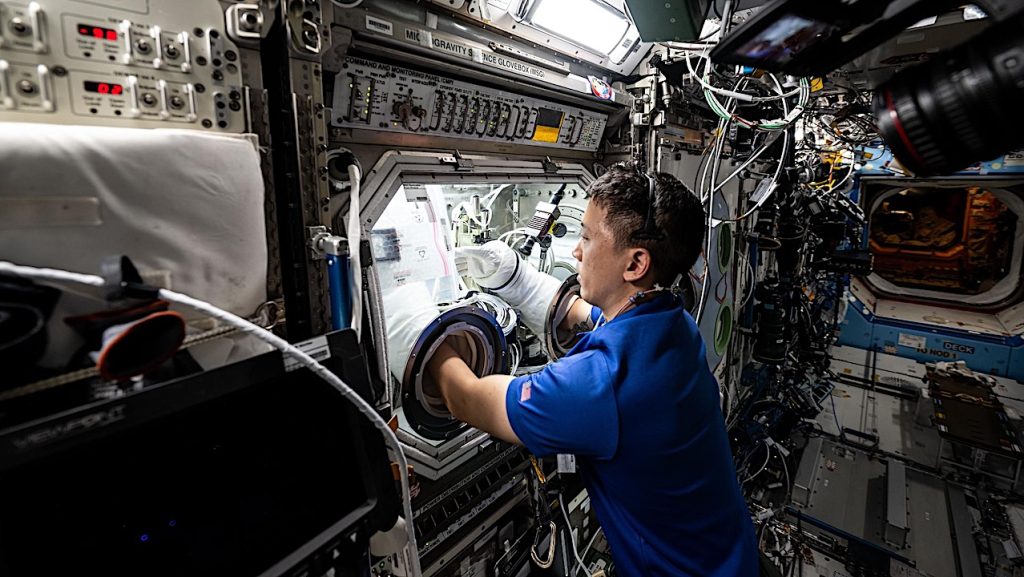
NASA quietly funded a new synthetic biology module deployed to the ISS in late 2024, designed to test the viability of engineered organisms under space conditions. The central experiment involves plasmid constructs containing genes from extremophiles like tardigrades combined with plant stress-resistance genes—a so-called hybrid “alien DNA.” Inside a contained bioreactor, the organism is exposed to microgravity, increased radiation, and simulated Martian atmosphere. The stated goal: pioneer strains of crops or microbes capable of resisting space radiation or producing oxygen, paving the way for long-term habitats on the Moon or Mars.

The module’s design relies on Gene Expression Systems (GExS) within sealed microfluidic chambers monitored by cameras and sensors. The jet of groundwater, nutrient mixing, and waste disposal are automated. NASA describes the project as a next-generation step in biotech life support, with major benefits in sustainability and closed-loop ecology.

But reports suggest a leak occurred during initial installation, when a valve in one chamber failed to seal due to microgravity-induced flexing. Ground control logs reveal anomalous pressure readings and fluid loss before crews intervened manually. No crew reported symptoms, and all lines were restabilized, but dead volumes in tubing remain unstudied—raising fears of escaped, synthetic organisms.

Scientific Upside: Radiation-Resistant Genetically Modified Crops

Proponents argue that radiation-resistant crops are essential for future space farming, as cosmic rays and solar storms wreak havoc on Earth-bred seeds. By splicing DNA from radiotolerant microbes into crop models or engineering tardigrade-like proteins for DNA repair, scientists hope to create edible biomass that can survive cosmic radiation. The ISS experiment tests whether such modified organisms can express key traits in microgravity, assess viability for oxygen and nutrient cycles, and close loops in future missions without Earth resupply.

The fallback promise is Earth-based too: engineering radiation-resistant or desiccation-tolerant crops could revolutionize agriculture in extreme environments on Earth—drought zones, nuclear cleanup areas, and polar regions.

Public Outcry & Legal Push: Crowdfunded Lawsuit

When NASA acknowledged the containment anomaly, biosecurity experts and international NGOs raised the alarm. In particular, a veterans’ bioethics group started crowdfunding to sue NASA for, they allege, violating the Outer Space Treaty and UN Liability Convention—both of which prohibit harmful contamination of space or celestial bodies and require safeguards against biologically hazardous activity.

Campaigners argue that introducing novel, untested life into orbit without transparent risk assessment or international oversight breaches Article IX of the OST, which states that states must avoid harmful contamination that would adversely change the environment of the Moon, Mars, or other celestial bodies. They also cite small print in NASA’s own biohazard protocols that mandate BSL-4 equivalent containment for synthetic organisms released into space. Since the ISS module reportedly encountered a leak, the plaintiffs say that proper biocontainment failed, and urgent third‑party environmental auditing is warranted.

Support for the suit has grown rapidly, fueled by mainstream media coverage and social media activism. The campaign argues that taxpayer-funded science must be held to the highest accountability standards, particularly when irreversible ecological or biological harms are at stake.
NASA’s Defense: Safety Protocols and Oversight Procedures

NASA maintains that the experiment remained confined, with redundant valves isolating the chamber and redundant filters preventing escape. Ground logs show pressure stabilized within two hours of the anomaly, and no organism was detected in external or service loops. The agency says it followed all protocols approved by NASA’s Institutional Biosafety Committee (IBC) and international partners under the ISS Inter-Agency Coordination Board (IACB).

NASA’s statement emphasizes that extreme radiation in space makes containment leaks inconsequential—radioactive decay would destroy any escaped microbe within weeks. They also argue that these missions are critical stepping stones before sending humans to deep space or genetically based terraforming experiments on Mars.

The Bigger Issue: Ethical Engineering Beyond Earth

Beyond the immediate conflict lies a deeper question—should humanity introduce synthetic biology into orbit or off-world before fully understanding potential risks? Until now, astrobiology has centered on avoiding terrestrial contamination of Mars, not creating novel organisms in space. The shift reflects a new frontier—biological engineering as a key enabler of deep space habitation, but also a powerful unknown tool.

Experts urge improved governance frameworks. Suggestions include mandatory real-time monitoring of containment volumes, third-party audits, and open sharing of data on failure modes. Some argue the experiment should be paused pending independent review. Others say delay is costly and undermines momentum for Mars readiness.

What’s at Stake: Earth and Beyond

If a leak led to contamination of shared facilities—or if future experiments generate transmissible or self-replicating organisms—it could compromise future missions, scientific research, or even environmental safety. And once biology escapes orbit, it may return in samples or through spacecraft reentry, bringing unknown risks to Earth.

Advocates warn the incident may mark a historic pivot: from robotic stewardship of space to active biological engineering. The choices we make now determine whether we become responsible cosmic citizens or repeat terrestrial environmental mistakes on a broader stage.

Conclusion: Turning Point for Space Biology

NASA’s “alien DNA” experiment straddles a threshold. It promises innovations in space farming and closed-loop ecosystems essential for future human presence beyond Earth. But it also exposes unanswered questions about liability, containment, and oversight. The cruise passengers we send into orbit carry our hopes and our risks.

As a citizen-backed lawsuit moves forward and NASA scientists prepare orbital reviews, space biology stands at a crossroads. Will future off‑world settlements rely on safe, monitored biotech environments—or will early missteps taint humanity’s cosmic footprint?

Meanwhile, one thing is clear: We have entered an era where life itself becomes part of our off‑Earth exploration. Whether we emerge as prudent stewards or reckless pioneers depends not just on science, but on our willingness to confront biohazards before point‑of‑no‑return moments.


Tags: alien DNA NASAISS synthetic biologyradiation-resistant cropsspace biohazard
ShareTweetShare

Related Posts

Should We Be Innovating Faster — or Smarter?
Innovation & Research

Should We Be Innovating Faster — or Smarter?

November 6, 2025
Has SpaceX Already Changed the Game, or Is the Real Revolution Still Coming?
Space Exploration

Has SpaceX Already Changed the Game, or Is the Real Revolution Still Coming?

November 6, 2025
Do Black Holes Hold Secrets to Time Travel?
Space Exploration

Do Black Holes Hold Secrets to Time Travel?

November 6, 2025
What Happens When Machines Start Innovating Themselves?
Innovation & Research

What Happens When Machines Start Innovating Themselves?

November 6, 2025
Which Matters More: Deep Space Exploration or Earth Observation?
Space Exploration

Which Matters More: Deep Space Exploration or Earth Observation?

November 4, 2025
Why Do Some Patents Kill More Ideas Than They Protect?
Innovation & Research

Why Do Some Patents Kill More Ideas Than They Protect?

November 4, 2025

Discussion about this post

  • Trending
  • Comments
  • Latest
Eternal Luminary: Humanity’s Perpetual Fascination with the Sun

Eternal Luminary: Humanity’s Perpetual Fascination with the Sun

November 5, 2024
The Race Heats Up: OpenAI Joins the AI-Powered Search Arena

The Race Heats Up: OpenAI Joins the AI-Powered Search Arena

October 16, 2024
The Canon DIGITAL IXUS Legacy: Redefining Photography with Style and Innovation

The Canon DIGITAL IXUS Legacy: Redefining Photography with Style and Innovation

November 2, 2024
A New Hope: Exploring KarXT’s Potential in Treating Alzheimer’s-Related Psychosis

A New Hope: Exploring KarXT’s Potential in Treating Alzheimer’s-Related Psychosis

December 5, 2024
The Lunar Symphony: Hal Clement’s Prophetic Fantasia

The Lunar Symphony: Hal Clement’s Prophetic Fantasia

Unlocking the Future with AI’s Latest Breakthroughs: A Journey into the Unchartered Frontier

Unlocking the Future with AI’s Latest Breakthroughs: A Journey into the Unchartered Frontier

The Transformative Power of Machine Learning: Shaping the Future of Technology and Beyond

The Transformative Power of Machine Learning: Shaping the Future of Technology and Beyond

The Emotional Intelligence of AI: Bridging the Gap Between Machines and Hearts

The Emotional Intelligence of AI: Bridging the Gap Between Machines and Hearts

Should We Be Innovating Faster — or Smarter?

Should We Be Innovating Faster — or Smarter?

November 6, 2025
Has SpaceX Already Changed the Game, or Is the Real Revolution Still Coming?

Has SpaceX Already Changed the Game, or Is the Real Revolution Still Coming?

November 6, 2025
Do Black Holes Hold Secrets to Time Travel?

Do Black Holes Hold Secrets to Time Travel?

November 6, 2025
What Happens When Machines Start Innovating Themselves?

What Happens When Machines Start Innovating Themselves?

November 6, 2025
techfusionnews

Discover the essence of innovation at "Tech Aggregator," where the latest in tech converges. From cutting-edge gadgets to cosmic ventures and green breakthroughs, our site offers a streamlined look at the future of technology. Engage with concise, impactful content designed for those eager to stay ahead in an ever-evolving digital landscape. Join us at the forefront of the tech revolution.

© 2025 techfusionnews.com. contacts:[email protected]

No Result
View All Result
  • Home
  • Digital Lifestyle
  • Green Tech & Wellness
  • AI
  • Space Exploration
  • Innovation & Research
  • All Tech

© 2025 techfusionnews.com. contacts:[email protected]

Welcome Back!

Login to your account below

Forgotten Password?

Retrieve your password

Please enter your username or email address to reset your password.

Log In