
















Introduction: When Science Meets Its Own Transformation
For centuries, the scientific method has remained remarkably stable.
Observation.
Hypothesis.
Experimentation.
Analysis.
Conclusion.
This structured approach has guided humanity’s greatest discoveries—from the laws of physics to the structure of DNA.
But something fundamental is changing.
Artificial Intelligence is not just accelerating science.
It is beginning to reshape how science itself is done.
And when the method of discovery changes, the nature of knowledge may change with it.
1. From Hypothesis-Driven to Data-Driven Science
Traditional science often begins with a hypothesis.
A researcher proposes an idea and designs experiments to test it.
AI introduces a different approach:
data-driven discovery.
Instead of starting with a hypothesis, scientists can:
- Analyze massive datasets
- Identify patterns
- Generate hypotheses automatically
In this model:
Data comes first.
Understanding comes later.
This reverses the traditional flow of scientific inquiry.
And it allows discoveries to emerge from patterns that humans might never notice.
2. The Scale Problem—and Its Solution
Modern science faces a scale problem.
There is simply too much data.
In fields like genomics, climate science, and particle physics, datasets are enormous.
No human can fully process them.
AI changes this.
Machine learning systems can:
- Analyze vast datasets quickly
- Detect subtle correlations
- Identify anomalies
This expands the scope of what science can explore.
Questions that were once impossible to investigate become accessible.
3. Pattern Recognition vs. Understanding
AI excels at finding patterns.
But pattern recognition is not the same as understanding.
A model might predict outcomes accurately without explaining why.
This creates a tension:
- Science seeks explanation
- AI often provides prediction
If a system can make accurate predictions without a clear explanation, is that enough?
For some applications, yes.
For others, no.
In medicine, for example, understanding mechanisms can be as important as predicting outcomes.
The challenge is integrating AI’s predictive power with human interpretability.
4. Automated Experimentation
AI is not just analyzing data—it is designing experiments.
In some fields, systems can:
- Propose experimental setups
- Optimize parameters
- Run simulations
- Analyze results
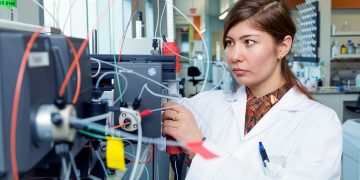
Combined with robotics, this leads to automated laboratories.
Experiments can be conducted:
- Faster
- More efficiently
- With fewer human interventions
This accelerates the cycle of discovery.
But it also changes the role of the scientist.
5. The Changing Role of Researchers
As AI takes over routine tasks, scientists shift from:
- Performing experiments
to - Designing systems
- Interpreting results
- Asking better questions
The value moves upstream.
Knowing what to ask becomes more important than knowing how to test it.
This is a subtle but profound shift.
Because the quality of science depends not just on answers—but on questions.
6. Collaboration Between Humans and Machines
AI is not replacing scientists.
It is augmenting them.
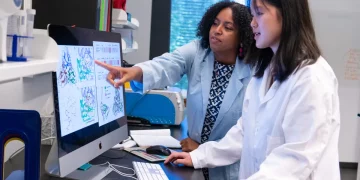
The most effective research increasingly involves collaboration:
- Humans provide intuition and context
- Machines provide scale and computation
This partnership can lead to new forms of discovery.
But it also requires new skills:
- Data literacy
- Computational thinking
- Interdisciplinary knowledge
The scientist of the future is not just a specialist.
They are a system thinker.

7. The Risk of Bias in Data-Driven Science
AI systems learn from data.
If the data is biased, the results will be too.
This is a significant concern in research.
Bias can enter through:
- Incomplete datasets
- Historical inequalities
- Measurement errors
And because AI operates at scale, these biases can be amplified.
This challenges the assumption that data-driven science is inherently objective.
It is not.
It is shaped by the data it relies on.
8. Reproducibility in the Age of AI
Reproducibility is a cornerstone of science.
An experiment should produce the same results when repeated.
AI complicates this.
Models can be:
- Sensitive to data variations
- Difficult to interpret
- Hard to replicate exactly
This raises questions:
- How do we verify results generated by complex models?
- How do we ensure transparency?
New standards and practices are needed.
Because without reproducibility, trust in science erodes.
9. Discovery Without Theory?
One of the most controversial implications of AI is the possibility of discovery without theory.
If a system can predict outcomes accurately, do we need to understand the underlying principles?
Some argue that prediction is enough.
Others see theory as essential.
Because theory provides:
- Explanation
- Generalization
- Deeper insight
The balance between prediction and understanding will shape the future of science.
10. The Future: Science as a System
Science is becoming more interconnected.
Data, models, experiments, and researchers form a continuous system.
AI acts as the glue:
- Connecting datasets
- Integrating knowledge
- Accelerating discovery
In this system:
Discovery is not a linear process.
It is dynamic.
Iterative.
Continuous.
Conclusion: Rethinking Discovery
AI is not just a new tool for science.
It is a new lens.
It changes how we see problems.
How we approach questions.
How we interpret results.
The scientific method is evolving.
Not being replaced—but expanded.
And as it evolves, so does our understanding of knowledge itself.
Because in the end, science is not just about finding answers.
It is about finding better ways to ask questions.













Discussion about this post