






























The concept of wormholes—hypothetical tunnels through the fabric of spacetime—has fascinated both physicists and science fiction enthusiasts for decades. Often depicted as shortcuts through vast cosmic distances or portals for time travel, wormholes have ignited the imagination of many. But can they actually exist? And if they do, could humanity one day use them to travel through time and space? Let’s dive into the physics behind wormholes, their potential uses, and the challenges that remain in making them a reality.
What Is a Wormhole?
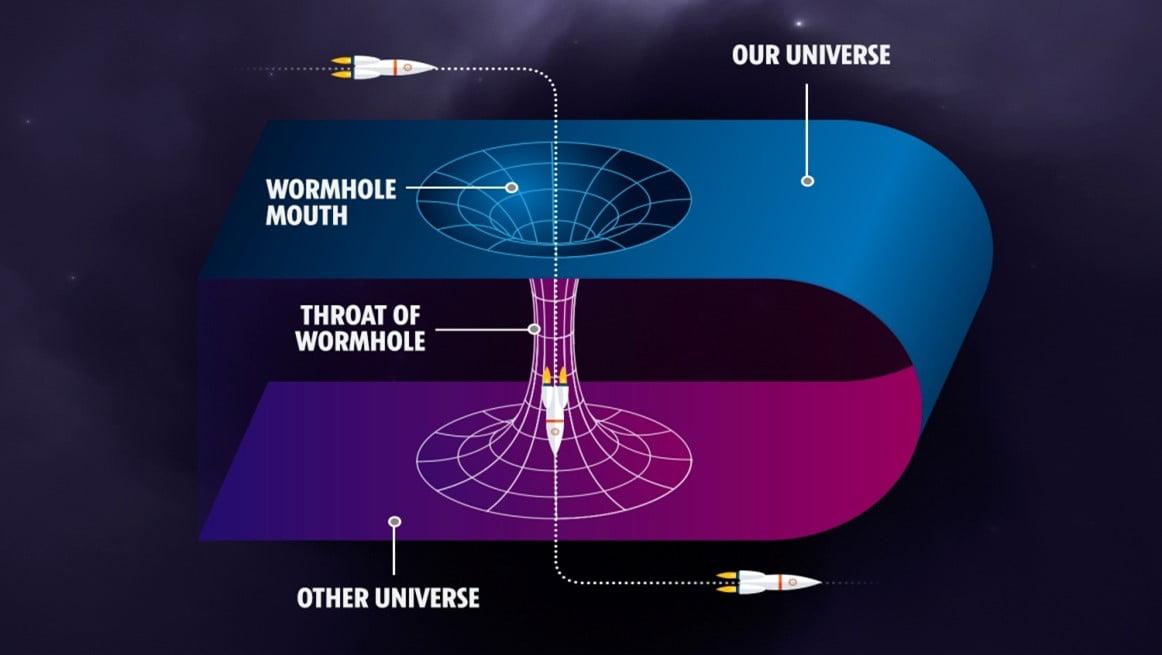
In the simplest terms, a wormhole is a theoretical passage through spacetime that could create shortcuts for long journeys across the universe. Imagine spacetime as a two-dimensional sheet. If you fold this sheet and create a tunnel between two distant points, you’ve created a wormhole. This “folding” of spacetime allows for a direct route between those two distant points, bypassing the vast distances that would otherwise exist between them.
Wormholes are also known as Einstein-Rosen bridges, named after physicists Albert Einstein and Nathan Rosen, who first proposed the idea in 1935. They derived the concept from Einstein’s general theory of relativity, which describes the gravitational forces that shape the universe. Wormholes are solutions to the equations of general relativity that theoretically allow for faster-than-light travel between different regions of spacetime.
Types of Wormholes
There are several types of wormholes hypothesized by scientists, though none have been observed to date. The most commonly discussed types include:
1. Traversable Wormholes
These are the kind of wormholes most frequently explored in science fiction. They could, in theory, allow humans or spacecraft to travel through them safely. A traversable wormhole would need to be stable and large enough to accommodate the passage of a spaceship or a person. The key challenge is keeping the wormhole open, as it would naturally tend to collapse under the influence of gravity.
2. Einstein-Rosen Bridge
This type of wormhole, as initially proposed by Einstein and Rosen, is not traversable. It connects two different points in spacetime but is unstable, collapsing almost instantly. While it’s a fascinating theoretical model, it’s not something that would allow for practical travel.
3. Wormholes Connecting Different Universes
Some theories even suggest the possibility that wormholes could connect not just distant points within our own universe, but entirely different universes altogether. This kind of wormhole would be a gateway to parallel realities or alternate dimensions, though it’s purely speculative and highly controversial.
How Would Wormholes Allow Us to Travel Through Time and Space?
The allure of wormholes is partly tied to their potential for time travel and space exploration. Here’s how they could theoretically help us travel through both:
1. Space Travel
The most obvious application of a wormhole would be for space travel. If we could create or find a wormhole that connects two distant regions of space, we could travel vast cosmic distances almost instantly. For instance, a trip to Alpha Centauri, our closest neighboring star system, could take just a matter of hours instead of over four years using conventional spacecraft. This would revolutionize space exploration and possibly allow us to colonize other star systems far beyond our own.
2. Time Travel
Wormholes might also offer a way to travel through time. The theory arises from the idea that if you could manipulate a wormhole in such a way that one end of it is in the distant past and the other end is in the future, you could effectively travel through time. This concept, known as “closed timelike curves” (CTCs), has been explored in various scientific papers. However, the practical realities of time travel, including potential paradoxes and causality violations, remain unclear and a major topic of debate.
Can Wormholes Exist?
Despite the theoretical elegance of wormholes, the question remains: Can they actually exist in our universe?
1. Theoretical Foundations
Wormholes are solutions to Einstein’s field equations of general relativity, so in principle, they could exist. However, these solutions often involve conditions—such as negative energy or exotic matter—that we have not observed in nature. This makes the idea of a stable, traversable wormhole highly speculative. Theories such as the “quantum foam” or “string theory” suggest that microscopic wormholes might exist at the quantum level, but scaling them up to human-size structures is far beyond our current technological capabilities.
2. Exotic Matter
One of the key ingredients necessary for a traversable wormhole is “exotic matter.” This hypothetical substance would have negative energy density, counteracting the gravitational forces that would otherwise collapse a wormhole. Exotic matter has not been discovered, though some theoretical models suggest it might exist in the form of certain types of quantum fields. The search for exotic matter is ongoing, but until it’s found, wormhole travel remains purely hypothetical.
3. The Stability Problem
Even if we could create a wormhole, keeping it open long enough for a spacecraft to travel through it is another massive hurdle. The immense gravitational forces at the mouth of the wormhole would likely cause it to collapse almost instantly. Theoretical physicists have suggested ways to stabilize a wormhole, but these methods often require exotic matter or energy forms that have not been observed in nature.
4. The No-Travel-Theorem
One of the most significant challenges to the possibility of wormhole-based time travel is the so-called “Chronology Protection Conjecture.” Proposed by Stephen Hawking, this conjecture suggests that the laws of physics may prevent time travel in order to preserve causality. In other words, the universe might have built-in mechanisms to stop paradoxical situations, such as traveling back in time and preventing your own birth.
Practical Applications of Wormhole Travel
If humanity could overcome the immense challenges associated with wormhole travel, the potential applications would be nothing short of transformative:

1. Interstellar Exploration
Wormholes could drastically shorten the time it takes to travel between distant star systems, opening the door for humanity to explore far-flung corners of the galaxy. With the search for exoplanets in full swing, the discovery of habitable worlds around distant stars could lead to interstellar expeditions. A wormhole-based transportation system could make these journeys possible, even in our lifetime.
2. Space Tourism
If wormholes could be stabilized and made safe, they could enable space tourism on an entirely new scale. The idea of visiting distant planets or moons—whether in our solar system or beyond—might be just a matter of hopping through a wormhole instead of enduring months of travel in a spacecraft. The entire concept of space tourism could evolve beyond Earth’s orbit.
3. Colonizing New Worlds
Humanity’s desire to colonize other planets is no secret, and with the threat of Earth’s future challenges (such as overpopulation or climate change), the idea of finding another home in the stars has never been more compelling. Wormholes could provide a means to colonize new worlds in distant star systems, bypassing the constraints of current space travel technologies.
4. Time Travel and Historical Research
Time travel, while fraught with paradoxes and theoretical issues, could open up entirely new avenues for understanding history. Imagine being able to observe key moments in history firsthand or even interact with past civilizations. This could offer an unprecedented way to study the past—though, of course, it would raise ethical concerns about influencing events.
The Challenges of Wormhole Travel
While the idea of traveling through wormholes is exhilarating, there are several obstacles that must be addressed before such travel becomes a reality.
1. Energy Requirements
The amount of energy required to create or stabilize a wormhole is currently beyond our technological capabilities. Even if exotic matter were discovered, the energy needed to manipulate spacetime on such a scale would likely be astronomical. The quest for new energy sources, such as fusion or dark energy, could be a key factor in enabling wormhole travel.
2. Technological Limitations
Creating and controlling a wormhole would require breakthroughs in technology that we can’t even begin to predict. Even if a wormhole could be artificially generated, how do we stabilize it? How do we ensure safe passage for humans or equipment? These are just some of the technical challenges that would need to be addressed.
3. Ethical and Philosophical Issues
Wormhole-based time travel presents numerous ethical and philosophical dilemmas. If time travel were possible, could we alter the course of history? Would we be able to prevent catastrophes or could we inadvertently cause them? The moral implications of manipulating time and space are profound and would require careful consideration.
Conclusion
Wormholes offer an exciting and tantalizing possibility for the future of space travel and time exploration. While the idea remains largely speculative, it is deeply rooted in the theories of general relativity and quantum mechanics, making it a subject of serious scientific inquiry. As we continue to explore the mysteries of the universe and advance our understanding of fundamental physics, who knows? Perhaps one day, the dream of traversing vast distances through wormholes will become a reality.
Until then, the concept will remain one of the most thrilling and mysterious ideas in science, blending cutting-edge physics with the allure of the unknown.












Discussion about this post