































The pursuit of interstellar travel—traveling between stars—is a topic that has captured the imagination of scientists, dreamers, and futurists alike. While current technology limits us to traveling within our own solar system, the concept of reaching distant stars, perhaps even inhabiting other planets, is a tantalizing prospect. One phenomenon that could potentially unlock the secrets of interstellar travel is the enigmatic black hole. But could these cosmic giants actually be the key to achieving travel between stars? The idea sounds like science fiction, but there may be more truth to it than we think.
In this article, we’ll explore the nature of black holes, the theories behind their potential role in interstellar travel, and the scientific and technological challenges that we must overcome to make this concept a reality. We’ll also examine the various types of black holes, their relationship with spacetime, and how they might serve as “cosmic shortcuts” through the universe.
What Are Black Holes?
Before diving into their potential as a tool for interstellar travel, it’s essential to understand what black holes are. At their core, black holes are regions of spacetime where gravity is so intense that nothing—not even light—can escape their gravitational pull. This makes them invisible to the naked eye, detectable only by their interaction with nearby matter or the bending of light around them.
Black holes form when massive stars collapse under their own gravity at the end of their life cycle. The core of the star becomes so dense that it creates a singularity—a point of infinite density at the center of the black hole. Surrounding this singularity is the event horizon, the boundary beyond which nothing, not even light, can escape.
There are three main types of black holes:
- Stellar Black Holes: These are the most common and form when massive stars collapse at the end of their life cycle. Stellar black holes typically have masses ranging from 3 to 10 solar masses.
- Supermassive Black Holes: These reside at the centers of galaxies and can have masses millions to billions of times that of our Sun. The supermassive black hole at the center of our own Milky Way is known as Sagittarius A*.
- Intermediate Black Holes: These are hypothesized to exist in between stellar and supermassive black holes. Their masses range from 100 to 1000 solar masses.
While the fundamental nature of black holes is understood, their full potential, especially in the context of interstellar travel, is still largely speculative.
Black Holes and Wormholes: Theoretical Shortcuts in Space
One of the most intriguing ideas surrounding black holes and interstellar travel is the possibility that they could provide shortcuts through space. The concept of a wormhole, or an Einstein-Rosen bridge, stems from Einstein’s theory of general relativity. According to this theory, massive objects warp spacetime around them. A wormhole is a theoretical passage through spacetime that connects two distant points in the universe.
Think of it as a tunnel with two ends, each at separate points in spacetime. If we could somehow enter a wormhole and traverse through it, we would be able to travel vast distances across the universe almost instantaneously. The mathematical models suggest that black holes, particularly those formed by the collapse of massive stars, could theoretically create such tunnels in spacetime.

Traversable Wormholes: Fact or Fiction?
While the idea of traversable wormholes is fascinating, it remains highly speculative. There are several obstacles that make this concept difficult, if not impossible, to test with our current technology:
- Exotic Matter: For a wormhole to be stable and traversable, it would require a form of “exotic matter”—matter with negative energy density that could counteract the immense gravitational forces and keep the wormhole open. Unfortunately, we have yet to discover or create exotic matter in any meaningful quantity.
- Causality and Time Travel: Wormholes, by their very nature, could potentially allow for time travel. The possibility of traveling backwards in time would introduce paradoxes (such as the famous “grandfather paradox”), leading scientists to question whether such phenomena are physically feasible.
- Energy Requirements: Even if we could find a way to stabilize a wormhole, the amount of energy required to create and maintain such a structure would likely be far beyond anything we can generate at present.
Despite these challenges, the mathematical foundations for wormholes are sound, and they remain a central topic in theoretical physics. If these theoretical constructs can be realized, they could provide a way to bypass the vast distances between stars.
The Potential for Using Black Holes as a Gateway to the Stars
Black Holes and the Alcubierre Drive
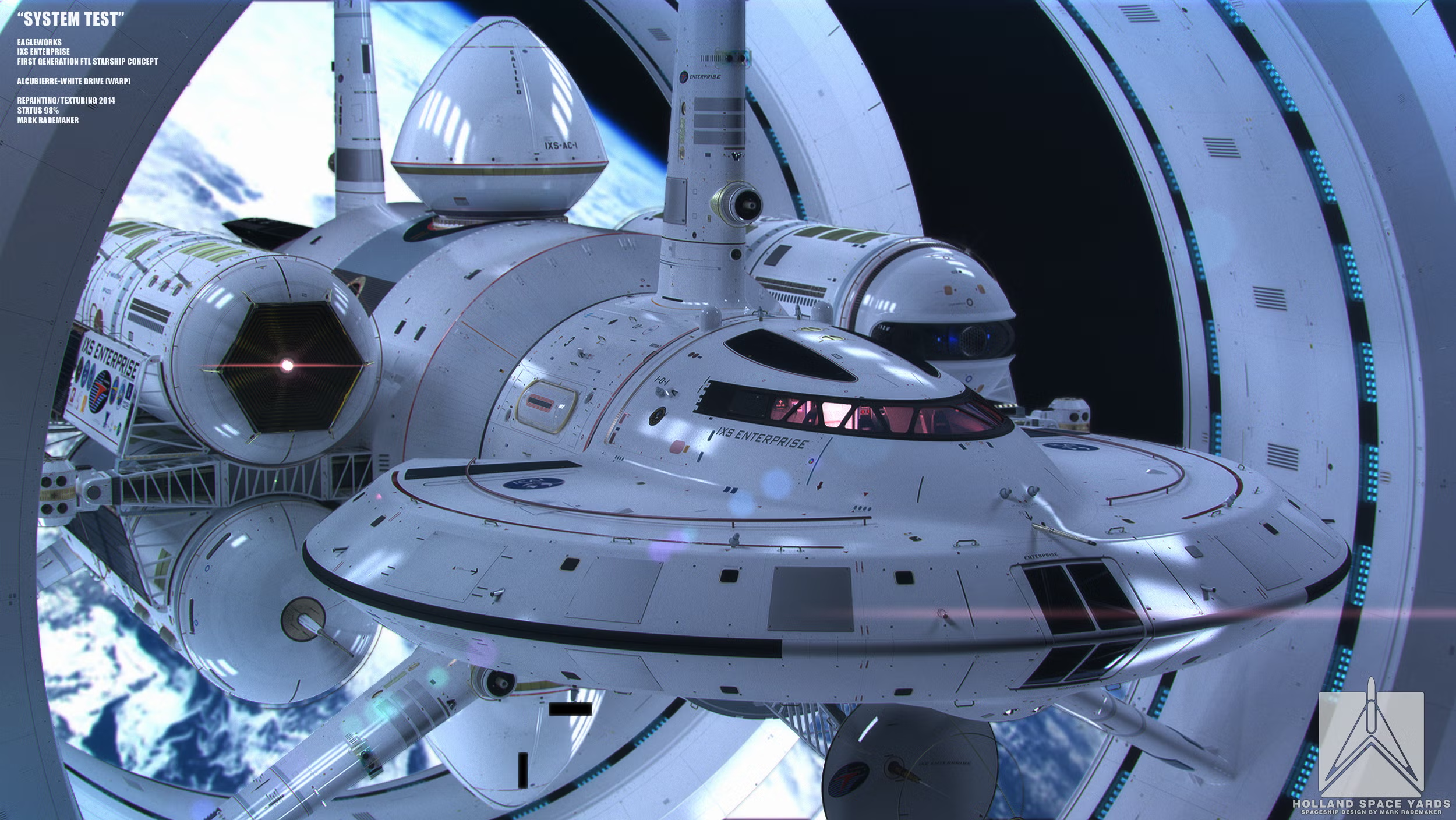
One of the most promising theoretical ideas to emerge in recent years is the concept of the Alcubierre Drive, a speculative faster-than-light propulsion system. Proposed by physicist Miguel Alcubierre in 1994, this concept uses the idea of warping spacetime itself to achieve faster-than-light travel.

The Alcubierre Drive doesn’t move a spacecraft through space in the traditional sense. Instead, it would create a “warp bubble” around the spacecraft, contracting space in front of the ship and expanding space behind it. This would theoretically allow the ship to travel faster than light without violating the laws of relativity, as the spacecraft itself wouldn’t be moving within the bubble—rather, the bubble would move through spacetime.
Theoretically, black holes could play a role in powering such a device. For example, the immense gravitational energy near a black hole could be harnessed to fuel the creation of a warp bubble. Some scientists speculate that if we can find a way to tap into the energy around black holes—perhaps through the process of Hawking radiation (a form of radiation emitted by black holes)—we might be able to create a warp drive capable of interstellar travel.
The Role of Hawking Radiation
Hawking radiation, proposed by physicist Stephen Hawking in 1974, is a theoretical prediction that black holes emit radiation due to quantum effects near the event horizon. While this radiation is incredibly weak and difficult to detect, it suggests that black holes could lose mass over time and eventually evaporate completely.
In the context of interstellar travel, Hawking radiation could provide a potential energy source. By capturing and harnessing the energy emitted by a black hole, we could theoretically power advanced spacecraft capable of traveling vast distances. However, capturing Hawking radiation would require technology far beyond what we have today, and it’s unclear whether we would be able to generate enough energy to propel a spacecraft to distant stars.
Navigating the Dangers of Black Holes
While black holes might hold the key to interstellar travel, they also present significant dangers. The most obvious risk is the intense gravitational pull near the event horizon. Crossing this threshold is impossible because any matter that falls in is crushed into the singularity, where it is obliterated. Even light cannot escape once it has passed the event horizon, making it virtually impossible to retrieve anything that has crossed this boundary.
Moreover, the idea of using black holes for travel implies we would need to find a safe way to enter and exit them. Entering a black hole through a stable wormhole might theoretically be possible, but emerging unscathed on the other side would be another challenge. It is unclear how, or even if, this would be feasible without disintegrating in the process.
Additionally, gravitational tidal forces near a black hole could be fatal. The difference in gravitational pull between the front and back of a spacecraft as it approaches the event horizon could stretch and tear the vessel apart in a process known as “spaghettification.”
The Future of Black Holes and Interstellar Travel
At this stage, the idea of using black holes for interstellar travel is still purely theoretical. We have yet to detect any wormholes or methods of harnessing the energy of black holes for practical purposes. However, this doesn’t mean the concept should be dismissed entirely. Advances in quantum mechanics, general relativity, and astrophysics could unlock new insights that allow us to explore the potential of black holes in ways we can’t yet imagine.
To make interstellar travel a reality, we would need to develop technologies capable of navigating extreme environments, generating and harnessing vast amounts of energy, and understanding the nature of spacetime on a deeper level. With breakthroughs in quantum computing, propulsion systems, and theoretical physics, the distant dream of interstellar travel might one day become a reality, with black holes playing an unexpected role in that journey.
Conclusion: Are Black Holes the Key to Interstellar Travel?
Black holes represent one of the most fascinating and mysterious aspects of the universe. Though they are often thought of as destructive and dangerous, black holes might also hold the key to unlocking the secrets of interstellar travel. Whether through wormholes, Hawking radiation, or warp drives, the possibilities are vast—and, for now, largely unexplored.
While many obstacles remain, the study of black holes is advancing rapidly. Theoretical physicists continue to develop models that could one day lead to practical applications for space travel. Until then, the idea of traveling to distant stars via black holes remains a tantalizing yet distant dream. But as our understanding of these cosmic giants deepens, who knows what future discoveries could one day allow us to leap across the stars?













Discussion about this post