




































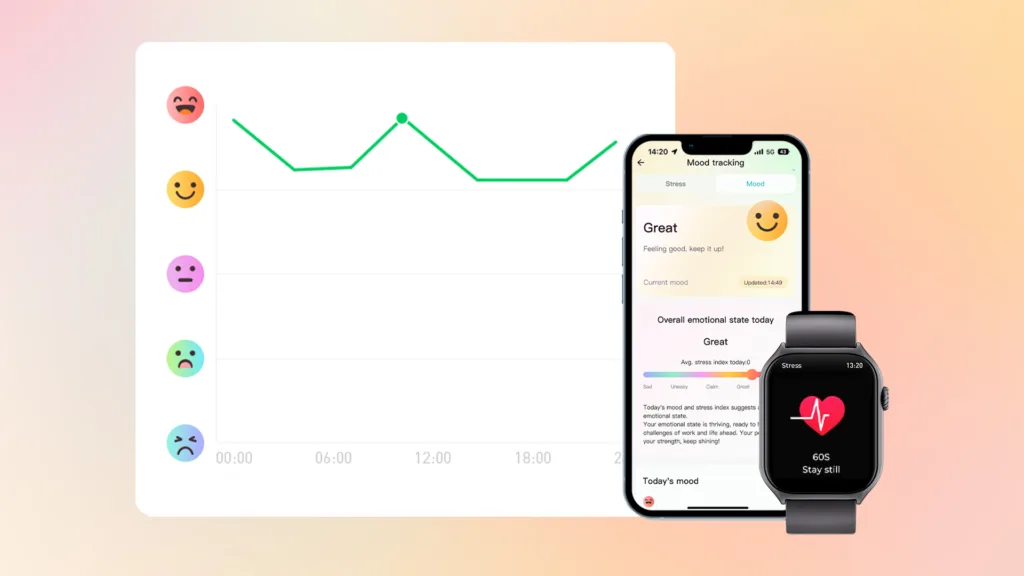
Introduction: From Step Counts to State of Mind
Not long ago, wearables were glorified pedometers. They counted steps, maybe tracked sleep, and congratulated you for walking an extra block. Today, they sit quietly on our wrists, fingers, ears, and even under our skin, collecting streams of physiological data that would have made medical researchers envious a decade ago. Heart rate variability, skin temperature, galvanic skin response, blood oxygen, movement micro-patterns, voice tone, breathing rhythm—these signals are no longer locked inside laboratories. They travel with us through meetings, workouts, arguments, naps, and moments of joy.
This explosion of data has sparked an ambitious and deeply intriguing question: can wearables predict your mood?
Not just detect stress after it happens. Not merely label a moment as “calm” or “active.” But predict mood changes before you consciously feel them—anticipating anxiety before it spikes, spotting depressive patterns early, or nudging you toward rest before burnout takes hold.
This article explores that question in depth. We will examine the science behind mood and physiology, the technologies powering mood prediction, the promises and pitfalls of emotional analytics, and the ethical terrain that lies beneath this emerging frontier. Along the way, we’ll separate hype from evidence, explore real-world use cases, and imagine what emotional intelligence might look like when it lives on your wrist.
Understanding Mood: A Complex, Slippery Target
Before asking whether wearables can predict mood, we need to ask a more fundamental question: what is mood, exactly?
Mood is not the same as emotion. Emotions are usually short-lived and tied to specific triggers—anger at a rude comment, joy at good news, fear when something goes wrong. Mood, on the other hand, is more diffuse and persistent. It is the emotional “weather” rather than the passing storm. You can wake up in a low mood without knowing why, or feel generally upbeat even when small annoyances pop up.
From a biological perspective, mood emerges from a complex interaction of factors:
- Neurochemical activity (such as serotonin, dopamine, and cortisol)
- Autonomic nervous system balance
- Hormonal cycles
- Sleep quality and circadian rhythms
- Physical health and inflammation
- Cognitive patterns and memory
- Environmental context and social interaction
No single signal defines mood. It is an emergent state—dynamic, layered, and deeply personal. This complexity is what makes mood prediction both fascinating and difficult.
The Physiological Clues Hidden in Plain Sight
Although mood is complex, it is not invisible. The body often knows what the mind is feeling before the conscious brain catches up.
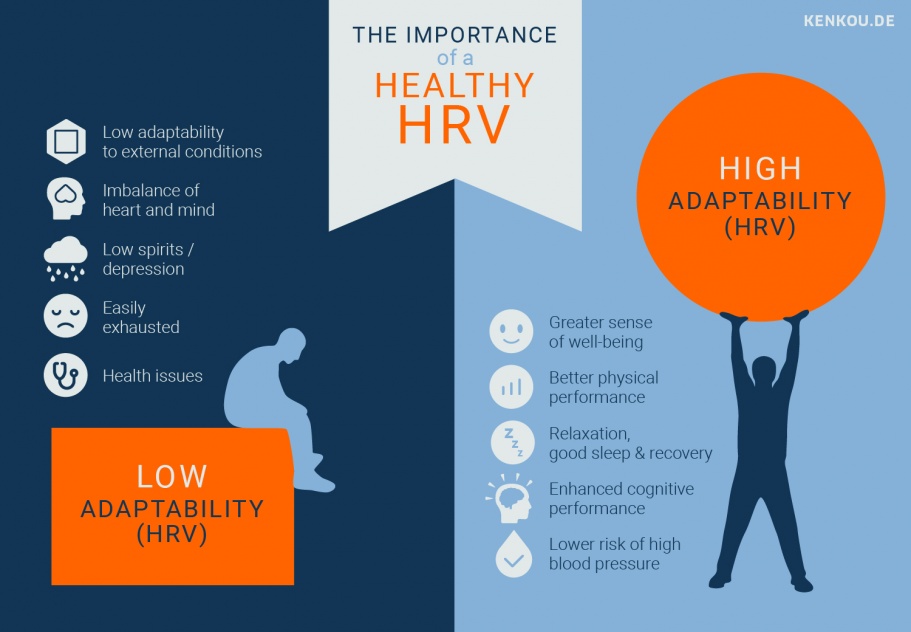
When stress builds, heart rate variability tends to decrease. When anxiety rises, breathing becomes shallower and faster. Depressive states often correlate with reduced movement, disrupted sleep, and flattened circadian rhythms. Excitement can raise skin temperature and increase micro-movements. Calm states are associated with slower respiration and more coherent heart rhythms.
Wearables are uniquely positioned to capture these signals continuously and passively. Unlike self-reports or questionnaires, they don’t rely on memory or honesty. They simply observe.
Key physiological indicators commonly used in mood-related analysis include:
- Heart Rate Variability (HRV): Often linked to stress resilience and emotional regulation.
- Resting Heart Rate: Can rise during prolonged stress or illness.
- Sleep Architecture: Changes in REM and deep sleep can reflect emotional health.
- Activity Patterns: Reduced variability or prolonged inactivity may correlate with low mood.
- Skin Conductance: Reflects sympathetic nervous system activation.
- Respiratory Rate: Sensitive to anxiety and relaxation states.
- Body Temperature Fluctuations: Tied to circadian rhythms and hormonal cycles.
Individually, these signals are ambiguous. Together, they form patterns—and patterns are where prediction begins.
From Raw Data to Emotional Insight: The Role of Machine Learning
Collecting data is easy. Interpreting it is the real challenge.
Mood prediction relies heavily on machine learning models trained to recognize subtle, multi-dimensional patterns over time. These systems do not “understand” mood in a human sense. Instead, they learn statistical relationships between physiological signals and reported emotional states.
The process typically looks like this:
- Data Collection: Wearables gather continuous streams of physiological data.
- Labeling: Users periodically report mood through prompts, surveys, or behavioral markers.
- Feature Extraction: Raw signals are transformed into meaningful metrics (e.g., HRV trends, sleep regularity).
- Model Training: Algorithms learn correlations between features and mood states.
- Prediction: The model estimates current or future mood based on incoming data.
Crucially, the most effective systems are personalized. Your baseline heart rate, sleep needs, and stress responses are not the same as anyone else’s. A heart rate of 75 might signal anxiety for one person and normalcy for another. Prediction improves as the system learns you.
Over time, models can begin to identify early-warning signatures: subtle shifts that tend to precede mood changes by hours or days. This is where prediction becomes proactive rather than reactive.
Accuracy: How Close Are We Really?
The idea of mood prediction sounds compelling—but how accurate is it?
The honest answer is: improving, but imperfect.
Current systems perform best with broad categories rather than nuanced emotional states. They are more reliable at identifying:
- High stress vs. low stress
- Calm vs. aroused states
- Regular vs. disrupted sleep-related mood shifts
- Burnout risk trends over time
They are less reliable at distinguishing between similar emotions (e.g., excitement vs. anxiety) or identifying complex mood disorders without additional context.
Several factors limit accuracy:
- Context Blindness: Wearables don’t fully understand why something is happening.
- Data Noise: Movement artifacts, sensor errors, and missing data complicate analysis.
- Individual Variability: Emotional expression differs widely between people.
- Feedback Loops: Knowing your mood is being tracked can change your behavior.
Despite these limitations, accuracy tends to improve with long-term use and personalized calibration. For many users, the value lies not in perfect prediction, but in pattern awareness.
Practical Applications: Where Mood Prediction Is Already Useful
Even without perfect accuracy, mood-aware wearables are finding real-world applications across multiple domains.
Mental Health Support
Mood prediction can act as an early-warning system. Subtle changes in sleep, activity, and autonomic balance may precede depressive episodes or anxiety spikes. Timely nudges—suggesting rest, social contact, or professional support—can make a meaningful difference.
Importantly, these tools are not diagnoses. They are signals, not verdicts. Used responsibly, they can complement human care rather than replace it.
Workplace Wellbeing
In high-pressure environments, chronic stress often goes unnoticed until performance drops or burnout hits. Aggregated, anonymized mood trends can help organizations design healthier schedules, identify systemic stressors, and encourage recovery—if privacy is handled ethically.
Fitness and Recovery
Mood is deeply intertwined with physical training. Overtraining often manifests emotionally before physically. Wearables that detect irritability, low motivation, or sleep disruption can recommend rest days or lighter sessions, optimizing both performance and mental health.
Personalized Lifestyle Coaching
Mood-aware systems can learn what improves or worsens your emotional state: caffeine timing, exercise type, social interaction, screen exposure, or bedtime routines. Over time, this becomes a personalized emotional map—one that evolves with you.
The Psychological Impact: When Being Measured Changes How You Feel
Tracking mood is not emotionally neutral.
For some users, mood insights feel empowering. They gain language for experiences they struggled to articulate. Patterns that once felt random become understandable. This can reduce self-blame and increase agency.
For others, constant monitoring can increase anxiety or self-surveillance. Seeing a “low mood prediction” might shape how someone interprets their day—even if they felt fine moments before. This phenomenon, sometimes called emotional priming, highlights a delicate balance between insight and intrusion.
Design matters. The most effective systems:
- Emphasize trends over moment-to-moment judgments
- Use supportive, non-alarmist language
- Encourage curiosity rather than correction
- Allow users to control feedback frequency and depth
Mood prediction should feel like a mirror, not a judge.
Privacy and Emotional Data: The Most Intimate Signal of All

If data is the new oil, emotional data is the most flammable kind.
Mood predictions are derived from physiological signals, but their implications reach deep into personal identity. Emotional states influence decisions, relationships, productivity, and vulnerability. Misuse of this data could enable manipulation, discrimination, or unwanted surveillance.
Key privacy concerns include:
- Who owns the emotional data?
- How is it stored and secured?
- Can it be sold, shared, or subpoenaed?
- Are predictions used to influence behavior without consent?
- What happens when emotional data is wrong?
Responsible systems prioritize local processing, encryption, transparency, and user control. Users should be able to delete data, opt out of certain analyses, and understand how predictions are generated at a high level.
Trust is not optional in mood-aware technology—it is foundational.
Bias and Fairness: Whose Mood Gets Understood?
Machine learning models learn from data. If that data reflects narrow demographics, the predictions will too.
Physiological baselines vary across age, gender, ethnicity, health status, and cultural context. Emotional expression is shaped by social norms and lived experience. A model trained on one population may misinterpret signals from another.
This raises important questions:
- Are mood prediction models inclusive?
- Do they account for hormonal cycles, chronic illness, or disability?
- Are emotional norms being silently standardized?
Improving fairness requires diverse datasets, continuous validation, and humility about what models do not know. Mood prediction should adapt to people—not the other way around.
The Future: From Prediction to Emotional Intelligence
As sensors improve and models mature, mood-aware wearables may evolve from predictors into collaborators.
Imagine systems that:
- Recognize when you need silence rather than motivation
- Adjust notifications based on emotional bandwidth
- Help you reflect on emotional cycles over months and years
- Support therapy with objective, longitudinal context
- Encourage emotional literacy rather than optimization
The ultimate goal is not to control mood, but to understand it. Not to flatten emotional life into metrics, but to deepen self-awareness through gentle feedback.
In this future, wearables are less like mood rings and more like emotional compasses—imperfect, but helpful when used wisely.
Conclusion: Can They Predict Your Mood?
So, can wearables predict your mood?
Yes—partially, probabilistically, and contextually.
They cannot read your mind. They cannot capture the full richness of human emotion. But they can detect patterns in the body that often precede or accompany mood changes. They can offer early signals, reflective insights, and supportive nudges that, for many people, are genuinely useful.
The real power of mood prediction lies not in accuracy alone, but in integration: blending physiological data with self-reflection, ethical design, and human judgment.
Mood is not a problem to be solved. It is a signal to be listened to. Wearables, when thoughtfully designed, can help us listen a little more closely—to ourselves.













Discussion about this post