


































Black holes have long captivated the imagination of astronomers and science enthusiasts alike. Often depicted as cosmic monsters that devour everything in their path, black holes are, in reality, much more complex entities with far-reaching influence on the universe. While a black hole’s gravitational pull is undeniably formidable, its role in shaping galaxies is subtle, multifaceted, and surprisingly crucial. In this article, we will explore how black holes, particularly the supermassive ones at galactic centers, dictate the evolutionary destiny of galaxies, orchestrate cosmic symphonies of matter and energy, and even contribute to the grand narrative of the universe itself.
Understanding Black Holes: The Basics
Before diving into galactic influence, it’s important to understand what black holes are. A black hole is a region in space where gravity is so intense that nothing—not even light—can escape its pull. They form when massive stars collapse at the end of their life cycle. The key characteristics of a black hole include the event horizon, beyond which nothing can return, and the singularity, a point of infinite density at the core.
There are different classes of black holes. Stellar-mass black holes, with masses ranging from a few to dozens of times that of the Sun, often form from supernova explosions. On the other end of the spectrum lie supermassive black holes, which reside at the centers of galaxies and can have masses billions of times that of the Sun. These giants are the principal players in influencing galactic fate.
The Galactic Heartbeat: Supermassive Black Holes
Almost every large galaxy harbors a supermassive black hole (SMBH) at its center. The Milky Way, for instance, hosts Sagittarius A*, a black hole with a mass roughly four million times that of the Sun. But these black holes are not mere passive entities lurking silently—they actively interact with their surroundings through processes collectively referred to as feedback mechanisms.
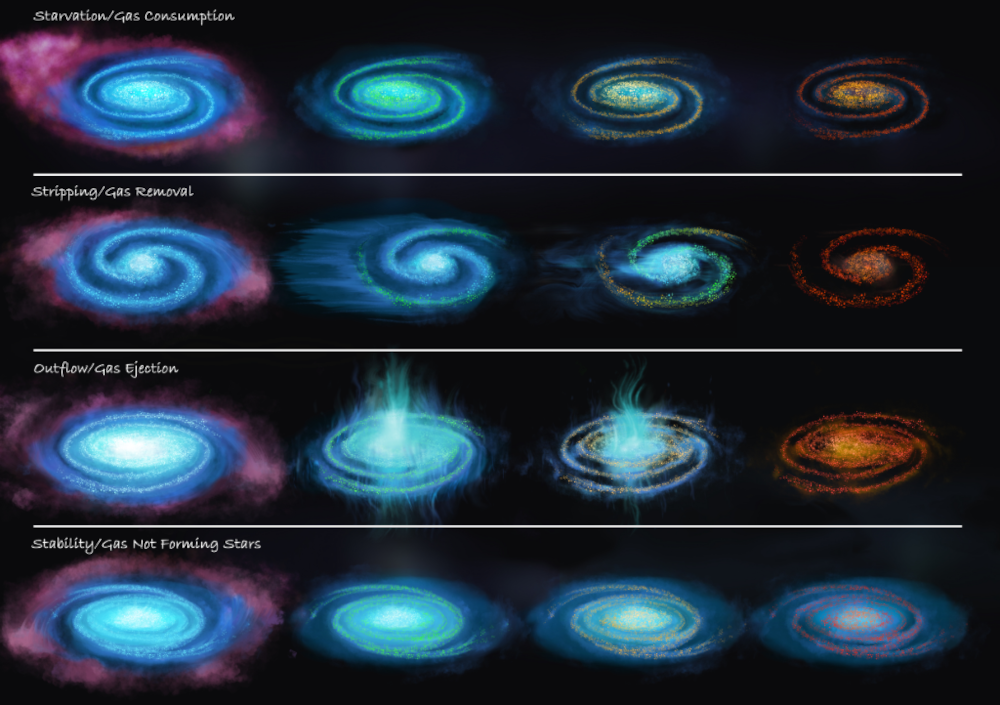
The influence of SMBHs is immense because they regulate the formation of stars and the distribution of gas within galaxies. When matter spirals into a black hole, it doesn’t simply vanish silently. Instead, some of it is converted into energy and ejected in powerful jets and winds, sometimes at velocities approaching the speed of light. These energetic outflows can heat surrounding gas, prevent it from collapsing into new stars, and even blow it out of the galaxy entirely.
Black Hole Feedback and Star Formation
Star formation is the lifeblood of a galaxy, determining its shape, brightness, and evolutionary path. Without new stars, a galaxy gradually fades into a dim, passive state dominated by old, red stars. Black holes influence this process directly. The energetic radiation and outflows from SMBHs can either quench or trigger star formation.
- Quenching: When black hole activity heats the interstellar medium or expels gas from the galaxy, it starves the galaxy of the raw material needed to form new stars. This phenomenon is common in massive elliptical galaxies, which appear dominated by older stars and lack significant star-forming regions.
- Triggering: Paradoxically, the same outflows can compress surrounding gas clouds, occasionally sparking bursts of star formation in localized regions. This dynamic interplay creates a galactic ecosystem where black holes act as both destroyers and creators.
This duality is crucial. Galaxies that are too active in forming stars can become unstable, while those entirely suppressed may stagnate. Black holes, in a sense, act as cosmic regulators, maintaining a delicate balance in galactic evolution.

Shaping Galactic Structure
Beyond star formation, black holes also influence the very structure of galaxies. Observations reveal a strong correlation between the mass of a galaxy’s central black hole and the properties of its stellar bulge—a relationship known as the M-sigma relation. This suggests that galaxies and their black holes grow in tandem, possibly through mutual feedback loops.
The gravitational dominance of an SMBH also affects the orbits of stars near the galactic core. Dense, energetic regions around black holes can form unique stellar configurations, such as nuclear star clusters, and even drive the migration of stars toward or away from the galactic center. Over billions of years, this influence can alter the shape and stability of the entire galaxy, sometimes transforming a spiral galaxy into an elliptical one.
Cosmic Jets: The Sculptors of the Universe
One of the most spectacular manifestations of black hole influence is the formation of relativistic jets. These narrow beams of charged particles shoot out from the poles of black holes at nearly the speed of light, extending across thousands of light-years. Jets carry enormous amounts of energy, capable of interacting with the intergalactic medium and neighboring galaxies.
Jets are not just visually striking—they play a pivotal role in galactic evolution. By heating the surrounding gas, they prevent it from cooling and collapsing into new stars. In galaxy clusters, jets from central black holes can regulate star formation on scales of millions of light-years. This phenomenon ensures that clusters do not form stars too rapidly, maintaining cosmic balance.
The Role of Mergers and Accretion
Galaxies are not isolated; they frequently collide and merge. When galaxies merge, their central black holes often spiral toward each other, eventually coalescing into an even more massive black hole. These mergers trigger intense periods of accretion, during which the black holes voraciously consume surrounding gas. The resulting energy output can be colossal, producing what astronomers call quasars, the brightest persistent objects in the universe.
Quasar activity has profound effects on galaxies. The energy released can expel massive amounts of gas, halt star formation, and even influence the chemical composition of the remaining gas. In this way, black holes are not passive bystanders but active participants in cosmic evolution, shaping galaxies long after the initial collision.
Black Holes as Galactic Ecosystem Engineers
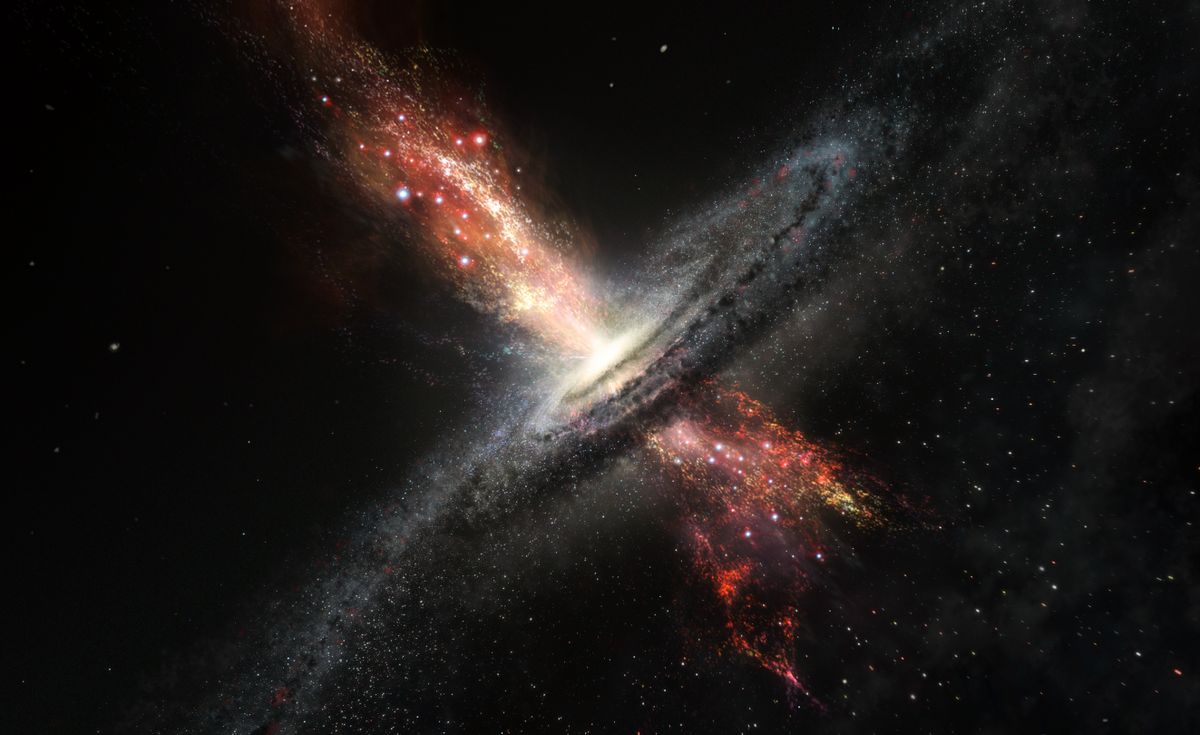
If we think of galaxies as living systems, black holes function as master regulators or “ecosystem engineers.” They influence the availability of star-forming material, control the rate of star formation, sculpt galactic morphology, and even regulate interactions with neighboring galaxies. Without black holes, galaxies might grow chaotically or fail to evolve into the well-structured systems we observe today.
Moreover, black holes play a key role in recycling matter within galaxies. When stars explode as supernovae or are tidally disrupted near black holes, their material is redistributed, enriching the interstellar medium with heavy elements essential for the next generation of stars and planets. This cyclical process underscores the interconnectedness between black holes and the broader galactic environment.
Black Holes and Galaxy Types
The impact of black holes varies with galaxy type. In spiral galaxies like the Milky Way, SMBHs coexist with active star-forming regions, gently regulating rather than completely suppressing stellar birth. In contrast, massive elliptical galaxies often exhibit evidence of past intense black hole activity that quenched star formation, leaving them dominated by older stellar populations.
Additionally, dwarf galaxies can also host intermediate-mass black holes. While their influence is proportionally smaller, even these black holes can stir gas, trigger starbursts, or destabilize small galaxies. Across the cosmic spectrum, black holes are intimately tied to galaxy identity, growth, and fate.
Observational Evidence: Peering into the Abyss
Modern astronomy has provided compelling evidence for black holes’ central role in galactic evolution. Observations from instruments like the Hubble Space Telescope and the Chandra X-ray Observatory reveal the impact of black hole jets, feedback-driven outflows, and quasar activity on surrounding gas. High-resolution imaging of galaxy centers shows how stars orbit SMBHs, highlighting the gravitational choreography orchestrated by these invisible giants.
Recent advances in gravitational wave astronomy add another layer to our understanding. Collisions between black holes produce ripples in spacetime, detectable across the cosmos. These events confirm the dynamic and evolving nature of black holes, emphasizing their role in shaping galaxies over billions of years.
Black Holes as Cosmic Timekeepers
Interestingly, black holes can also serve as cosmic clocks. By studying the growth history of SMBHs, astronomers can infer the timeline of galaxy formation and evolution. The mass and activity of a central black hole often reflect the cumulative history of galactic mergers, star formation bursts, and gas inflows. In this sense, black holes are not just agents of change—they are historical records etched into the fabric of the universe.
Challenges and Frontiers
Despite decades of research, black holes remain enigmatic. Many questions about their precise role in galactic evolution are still under investigation. How exactly do feedback mechanisms balance star formation across different types of galaxies? What triggers transitions between active and dormant phases of black holes? And how do intermediate-mass black holes influence small galaxies? These frontiers represent some of the most exciting challenges in modern astrophysics.
Future telescopes, like the James Webb Space Telescope and next-generation radio arrays, promise unprecedented insights. By observing black holes across cosmic time and in diverse environments, astronomers hope to untangle the complex interplay between these gravitational titans and their host galaxies.
Conclusion: Architects of the Cosmos
Black holes are far more than cosmic vacuum cleaners—they are architects, regulators, and historians of the universe. Their gravitational might, energetic outflows, and dynamic interactions shape the destiny of galaxies, regulate star formation, and even influence the broader structure of the cosmos. Understanding black holes is thus essential not only to comprehend the fate of individual galaxies but also to grasp the grand tapestry of cosmic evolution.
In essence, black holes act as the hidden hands guiding the lifecycle of galaxies, ensuring that the universe evolves in a balanced and fascinatingly complex way. Far from being mere destructive forces, they are indispensable to the story of how galaxies live, grow, and transform over billions of years.













Discussion about this post