



































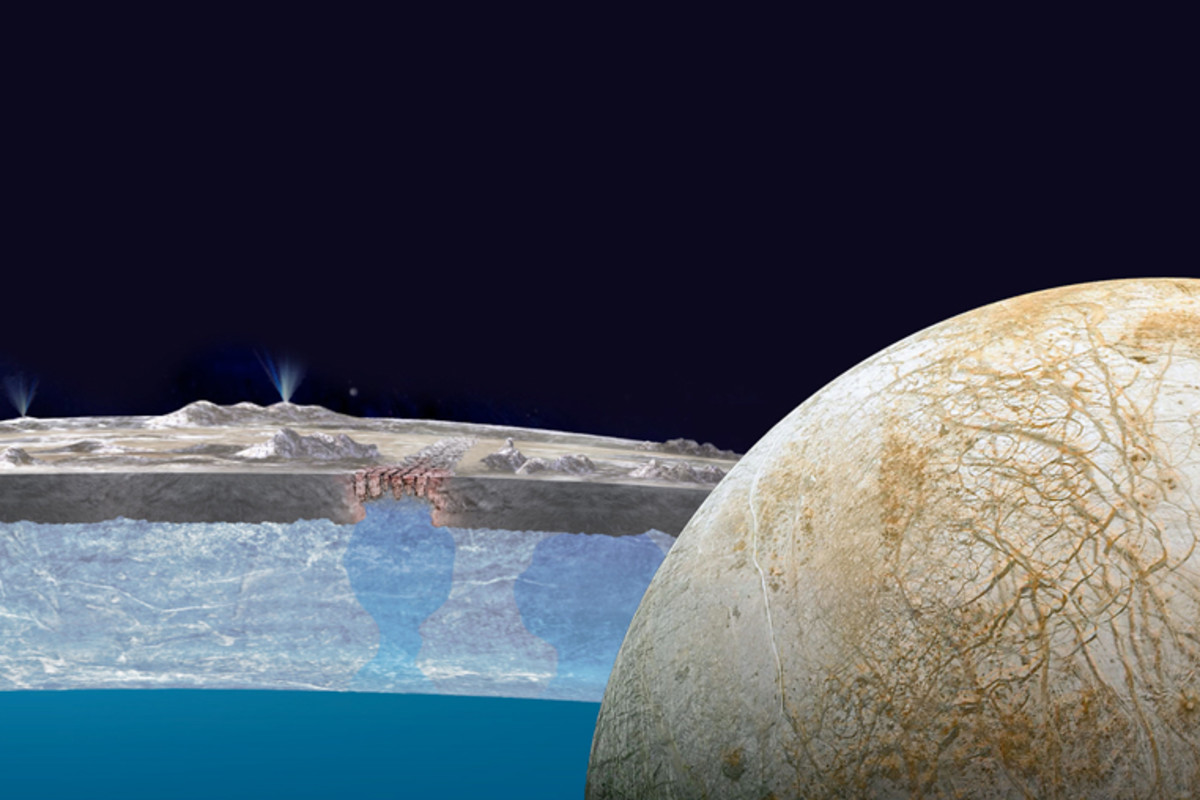
Imagine a world where alien oceans flow beneath a thick, frozen crust, entirely hidden from the sun’s warmth. Europa, one of Jupiter’s most intriguing moons, has captured the imagination of scientists, writers, and dreamers alike. Its smooth, icy surface, streaked with reddish-brown lines, hints at something extraordinary: a global subsurface ocean that may rival Earth’s own in volume. But what if that ocean isn’t just water? What if it teems with life?
The implications of discovering life in Europa’s hidden seas are profound, touching everything from biology and planetary science to philosophy and the future of humanity’s place in the cosmos. In this article, we explore the scientific, technological, and societal consequences of such a discovery, all while diving into the tantalizing mysteries of Europa’s icy world.
Europa: An Ocean World in the Cold
Europa is slightly smaller than Earth’s Moon, yet it has captured far more attention. Orbiting Jupiter every 3.5 days, Europa is constantly tugged and stretched by the immense gravitational forces of its parent planet and neighboring moons. This tidal flexing generates heat beneath the surface, enough to keep a vast ocean of liquid water from freezing solid. Scientists estimate that Europa’s ocean could contain twice as much water as all of Earth’s oceans combined.
Beneath its icy shell, estimated to be between 15 and 25 kilometers thick, Europa’s ocean is thought to be in contact with a rocky seafloor. This interface is critical, because on Earth, life thrives where water meets rock in hydrothermal vent systems. Could the same be true on Europa? The answer may redefine our understanding of life in the universe.
Life in the Dark: How Could It Exist?
Life on Earth relies on sunlight to drive photosynthesis, forming the foundation of most ecosystems. But beneath Europa’s ice, sunlight is essentially nonexistent. If life exists there, it must rely on alternative energy sources. Scientists have identified several possibilities:
1. Hydrothermal Vents
On Earth, hydrothermal vents provide heat and minerals to support complex ecosystems in the deep ocean. Microbes thrive by converting chemical energy into biological energy, a process known as chemosynthesis. If Europa’s ocean floor harbors similar vents, they could provide a stable habitat for life.
2. Radiolysis of Water
Europa’s surface ice is constantly bombarded by Jupiter’s intense radiation. This radiation can split water molecules into hydrogen and oxygen. Over time, this chemical energy could seep into the ocean below, offering a potential energy source for microbes.
3. Subsurface Chemical Reactions
Europa’s ocean may interact with the underlying rocky mantle, creating chemical gradients similar to those on Earth that sustain life. Reactions between water and minerals could generate hydrogen, methane, or other compounds that microbes could use for energy.
While these mechanisms are speculative, they suggest that life in Europa’s ocean might be possible—even without sunlight.
What Could Europan Life Look Like?
Predicting the form that life might take under Europa’s ice is an exercise in imagination tempered by biology. It’s likely that any organisms would be microscopic and extremophilic, capable of surviving in high pressure, cold temperatures, and low nutrient availability.

Some possibilities include:
- Microbes: Simple bacteria-like organisms could dominate, using chemosynthesis to convert chemical energy into biomass.
- Multicellular Life: If the ocean is stable and nutrient-rich enough, small multicellular organisms might evolve. Think of Earth’s deep-sea tube worms or shrimp-like creatures.
- Unique Biochemistry: Life might not even rely on DNA or RNA. Alternative biochemical pathways, such as silicon-based compounds or exotic amino acids, could emerge in such an alien environment.
The discovery of such life would challenge the anthropocentric view that life must resemble that of Earth. It would confirm that biology is adaptable, capable of thriving in conditions we previously considered inhospitable.
The Scientific Implications
Finding life in Europa’s subsurface ocean would trigger a seismic shift in multiple scientific disciplines:
Astrobiology
Astrobiology would move from speculative theory to observational reality. Europa would become a natural laboratory for studying alien biology, revealing how life adapts to extreme conditions and possibly shedding light on life’s origins on Earth.
Planetary Science
Understanding Europa’s geophysics would take on new urgency. Scientists would study how heat, chemical energy, and ocean dynamics sustain life beneath the ice. Models of ice-ocean interaction would be refined to predict where life is most abundant.
Chemistry and Biochemistry
New forms of metabolism could be uncovered. Europan microbes might employ novel energy conversion mechanisms or molecular structures, providing insights into the diversity of life’s chemical possibilities.
Earthly Applications
Life from Europa might inspire breakthroughs in biotechnology. Extremophilic enzymes, resilient proteins, or unique biochemical pathways could have applications in medicine, industry, or environmental engineering.
Technological Challenges: How Could We Explore Europa?
Exploring a hidden ocean beneath kilometers of ice is no small feat. Current technology faces immense hurdles:
Ice Penetration
Drilling through 15–25 km of ice is beyond today’s capabilities. Proposed solutions include melting probes powered by nuclear energy or advanced robotics capable of tunneling through ice.
Sterilization
Contamination is a serious concern. Any mission must prevent Earth microbes from entering Europa’s ocean, both to protect native life and to preserve scientific integrity.
Remote Sensing
Orbital missions like NASA’s Europa Clipper will map the surface, analyze plumes, and detect potential hotspots. These observations will guide future missions to the most promising locations for life detection.
Submersible Robots

Future missions may deploy autonomous submersibles capable of navigating the dark, high-pressure ocean, analyzing water chemistry, and capturing images of potential organisms.
While these missions are decades away, technological progress continues rapidly. The dream of exploring Europa’s ocean may soon move from science fiction to reality.
Philosophical and Societal Implications
The discovery of life beyond Earth would reverberate far beyond science. Humanity would face profound questions:
Redefining Life
Finding extraterrestrial life would force us to expand our definition of life itself. Are we biologically exceptional, or just one example of a universal principle?
Spiritual and Cultural Impact
Religious, philosophical, and cultural frameworks would be challenged. Some might see life on Europa as evidence of cosmic interconnectedness; others might struggle with the implications for humanity’s uniqueness.
Ethical Considerations
If life exists on Europa, should we protect it? The debate over planetary protection would intensify. Do we risk contamination for knowledge, or preserve alien ecosystems as sacred, untouched realms?
Future of Human Exploration
Europa could become a focal point for interplanetary research and exploration. The presence of life might redefine priorities in space policy, funding, and international cooperation.
Europa in the Context of the Solar System
Europa is not alone in harboring the potential for life. Other moons, such as Saturn’s Enceladus and Titan, also exhibit subsurface oceans or organic-rich environments. However, Europa’s combination of liquid water, energy sources, and stable conditions makes it a prime candidate.
Finding life on Europa would raise the odds that the universe is teeming with life. If life arose independently on one icy moon, it might be common wherever conditions permit. Such a discovery would fundamentally alter our understanding of life’s prevalence and resilience.
Detecting Life: What Would It Look Like?
Detecting life in Europa’s ocean will be tricky. Scientists will look for multiple indicators:
- Chemical Signatures: High concentrations of organic molecules, unusual isotopic ratios, or compounds like methane could suggest biological activity.
- Physical Evidence: Microfossils or unusual structures in ice or rock could provide visual proof of life.
- Plumes and Ejecta: Europa occasionally ejects water into space via surface fractures. Sampling these plumes might reveal microbial life without drilling through ice.
Combining these methods will give the best chance of confirming life without direct sampling of the ocean floor.
Life’s Cosmic Perspective
If we find life on Europa, it will no longer be a distant possibility—it will be a concrete reality. Humanity’s understanding of its place in the cosmos will shift dramatically.
No longer would Earth be the sole cradle of life. Europa would serve as a reminder that life is resilient, adaptable, and possibly ubiquitous. The discovery could inspire generations of scientists, artists, and explorers, fueling a new era of curiosity and ambition.
Conclusion: A Universe Teeming with Possibility
The prospect of life in Europa’s subsurface ocean is both thrilling and humbling. From its hidden depths, life may offer clues about biology, chemistry, and the origins of life itself. The technological and ethical challenges of exploring this alien ocean are immense, yet humanity is steadily moving toward that frontier.
Whether Europa harbors simple microbes, complex organisms, or forms of life entirely unlike our own, the discovery would be a milestone in the story of human understanding. It would remind us that the universe is vast, mysterious, and brimming with possibilities that we are only beginning to imagine.
The frozen moon, once just a speck of light orbiting Jupiter, would become a symbol of curiosity, hope, and the boundless potential of life.













Discussion about this post